
By Bob Sorokanich, senior editor, GM News
Once-lost sculpture by Detroit artist Harry Bertoia finds a new home at GM global headquarters
2025-12-11
Artist Harry Bertoia’s work is woven into the DNA of Detroit. His first public sculpture installation was commissioned for the General Motors Global Technical Center in Warren, Michigan in 1953. Now, General Motors is proud to re-introduce another Bertoia work, showcased at its new global headquarters at Hudson’s Detroit – a sculpture that had gone missing for decades.
Bertoia was born in Italy in 1915, but his art career took flight when he emigrated to Detroit. A graduate of Cass Technical High School, he attended the Art School of the Detroit Society of Arts and Crafts – now known as the College for Creative Studies – before receiving a scholarship to study at the prestigious Cranbrook Academy of Art in Bloomfield Hills.
In the post-World War II era, Michigan was at the center of the modernist design movement. Partly inspired by the daring jet-age styling of American automobiles, the modernist movement sought to combine fine art and industrial design, creating works that were both beautiful and functional. Florence Knoll, a fellow Cranbrook alum, would recruit Bertoia to design furniture for Knoll Associates, launching the iconic Bertoia Collection and the influential Diamond Chair.
GALLERY OF 2 IMAGES:
GALLERY CAPTION: The Eero Saarinen-designed General Motors Global Technical Center, photographed in the mid-1950s.
In 1953, groundbreaking architect Eero Saarinen received his first solo commission: The General Motors Global Technical Center. Saarinen envisioned a sprawling, self-contained collection of brand-new buildings – the first instance of the modern corporate campus – all designed to a singular modern style that evoked the technological advancements taking place within GM.
Art was integral to Saarinen’s vision for the Technical Center, and thus, Bertoia and many other leaders of modernist sculpture were commissioned to contribute to the architect’s grand vision, including Alexander Calder’s Water Ballet sculpture, the Bird in Flight sculpture by Antoine Pevsner, and the General Motors Research painting by Charles Sheeler.
GALLERY OF 3 IMAGES:
GALLERY CAPTION: “Water Ballet” fountain by Alexander Calder; “Bird in Flight” sculpture by Antoine Pevsner; “General Motors Research” painting by Charles Sheeler
Bertoia’s contribution bridged architecture, décor, and functional industrial design: A 36-foot-long, 10-foot-tall screen composed of hundreds of rectangular steel plates coated in molten brass and bronze, mounted on vertical steel rods. Massive and monolithic from a distance, Bertoia’s Untitled Wall Screen becomes elegant and airy as the viewer draws near. Natural light pierces the grid, illuminating the space in warm, welcoming golden hues. “Light is the sculptor’s most important partner,” Bertoia had said. “The play of light on metal gives life to the form; without light, sculpture does not exist.”
CAPTION: “Untitled Wall Screen” viewed from inside the Cadillac House at Vanderbilt.
The Bertoia installation defined the entire western-facing wall of GM’s Central Restaurant – a building known today as the Cadillac House at Vanderbilt, where GM designers consult with clients to create each bespoke, individually-appointed CELESTIQ ultra-luxury sedan. This centerpiece earned Bertoia an Honor Award from the American Institute of Architects (AIA) in 1955, and was the first of more than 50 major public works completed by the artist during his lifetime.
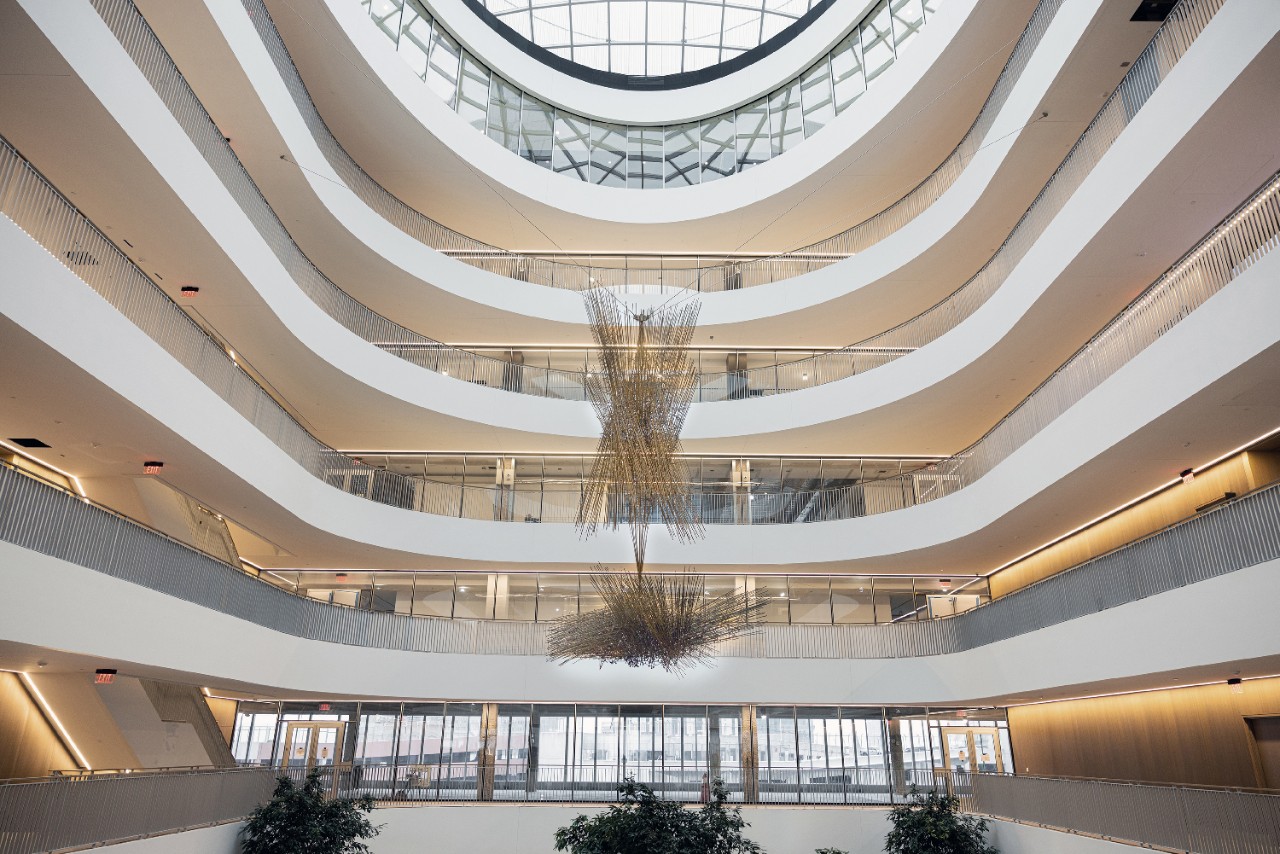
In 1970, when Bertoia was an established leader in modernist sculpture, the J.L. Hudson Company commissioned an installation for the Genesee Valley Mall in Flint, Michigan. Bertoia’s creation was monumental in size, yet delicate in appearance: A 26-foot-tall sculpture that takes the form of two large clouds, constructed of steel wire coated in melted brass, bronze, and metal alloys.
In 1980, when the Genesee Valley Mall was shuttered for renovation, the Bertoia sculpture was moved to the Northland Mall in Southfield, Michigan. There, it vanished from public view for decades; when the Northland Mall was later demolished, it was feared that the Bertoia installation had been lost for good.
Miraculously, in 2017, appraisers from the Southfield Arts Commission discovered the lost Bertoia beneath layers of dirt in the basement of the demolished mall. The City of Southfield then purchased the artwork, and restoration was begun.
When General Motors announced its new headquarters on the site of the former J.L. Hudson’s department store on Woodward Avenue, the historic Detroit location provided the perfect home for the rediscovered Bertoia. Installing the heroic sculpture was a massive undertaking. A five-story-high opening had to be “unzipped” in the side of the Hudsons Detroit building. The sculpture was threaded through the 15-foot-wide, 75-foot-tall opening in two pieces, involving a complex ballet of chain-falls and cranes to safely transport the historic artwork.
INSERT VIDEO HERE
With the lost Bertoia now permanently installed, the new GM headquarters at Hudsons Detroit showcases a work with deep connections to General Motors, to the city of Detroit, and to the midcentury arts movement that helped define the modern aesthetic.
“Having a Harry Bertoia sculpture in our new global headquarters in Hudson’s Detroit is incredibly meaningful,” said Crystal Windham, executive director of industrial design at General Motors. “Bertoia was a master at shaping metal, a principle that resonates deeply with our work in automotive design. His iconic screen at Cadillac House at Vanderbilt on our Global Technical Center campus is a legendary part of our design heritage. Now, this magnificent piece, with its own story of being lost and found, bridges GM’s past with our future. It serves as a daily inspiration, a powerful symbol of the creativity and resilience that has always defined both General Motors and the city of Detroit.”
Artist Harry Bertoia’s work is woven into the DNA of Detroit. His first public sculpture installation was commissioned for the General Motors Global Technical Center in Warren, Michigan in 1953. Now, General Motors is proud to re-introduce another Bertoia work, showcased at its new global headquarters at Hudson’s Detroit – a sculpture that had gone missing for decades.
Bertoia was born in Italy in 1915, but his art career took flight when he emigrated to Detroit. A graduate of Cass Technical High School, he attended the Art School of the Detroit Society of Arts and Crafts – now known as the College for Creative Studies – before receiving a scholarship to study at the prestigious Cranbrook Academy of Art in Bloomfield Hills.
In the post-World War II era, Michigan was at the center of the modernist design movement. Partly inspired by the daring jet-age styling of American automobiles, the modernist movement sought to combine fine art and industrial design, creating works that were both beautiful and functional. Florence Knoll, a fellow Cranbrook alum, would recruit Bertoia to design furniture for Knoll Associates, launching the iconic Bertoia Collection and the influential Diamond Chair.
The Eero Saarinen-designed General Motors Global Technical Center, photographed in the mid-1950s.
In 1948, groundbreaking architect Eero Saarinen received his first solo commission: The General Motors Global Technical Center. Saarinen envisioned a sprawling, self-contained collection of brand-new buildings – the first instance of the modern corporate campus – all designed to a singular modern style that evoked the technological advancements taking place within GM.
Art was integral to Saarinen’s vision for the Technical Center, and thus, Bertoia and many other leaders of modernist sculpture were commissioned to contribute to the architect’s grand vision, including Alexander Calder’s Water Ballet sculpture, the Bird in Flight sculpture by Antoine Pevsner, and the General Motors Research painting by Charles Sheeler.
“Water Ballet” fountain by Alexander Calder; “General Motors Research” painting by Charles Sheeler; “Bird in Flight” sculpture by Antoine Pevsner
Bertoia’s contribution bridged architecture, décor, and functional industrial design: A 36-foot-long, 10-foot-tall screen composed of hundreds of rectangular steel plates coated in molten brass and bronze, mounted on vertical steel rods. Massive and monolithic from a distance, Bertoia’s Untitled Wall Screen becomes elegant and airy as the viewer draws near. Natural light pierces the grid, illuminating the space in warm, welcoming golden hues. “Light is the sculptor’s most important partner,” Bertoia had said. “The play of light on metal gives life to the form; without light, sculpture does not exist.”
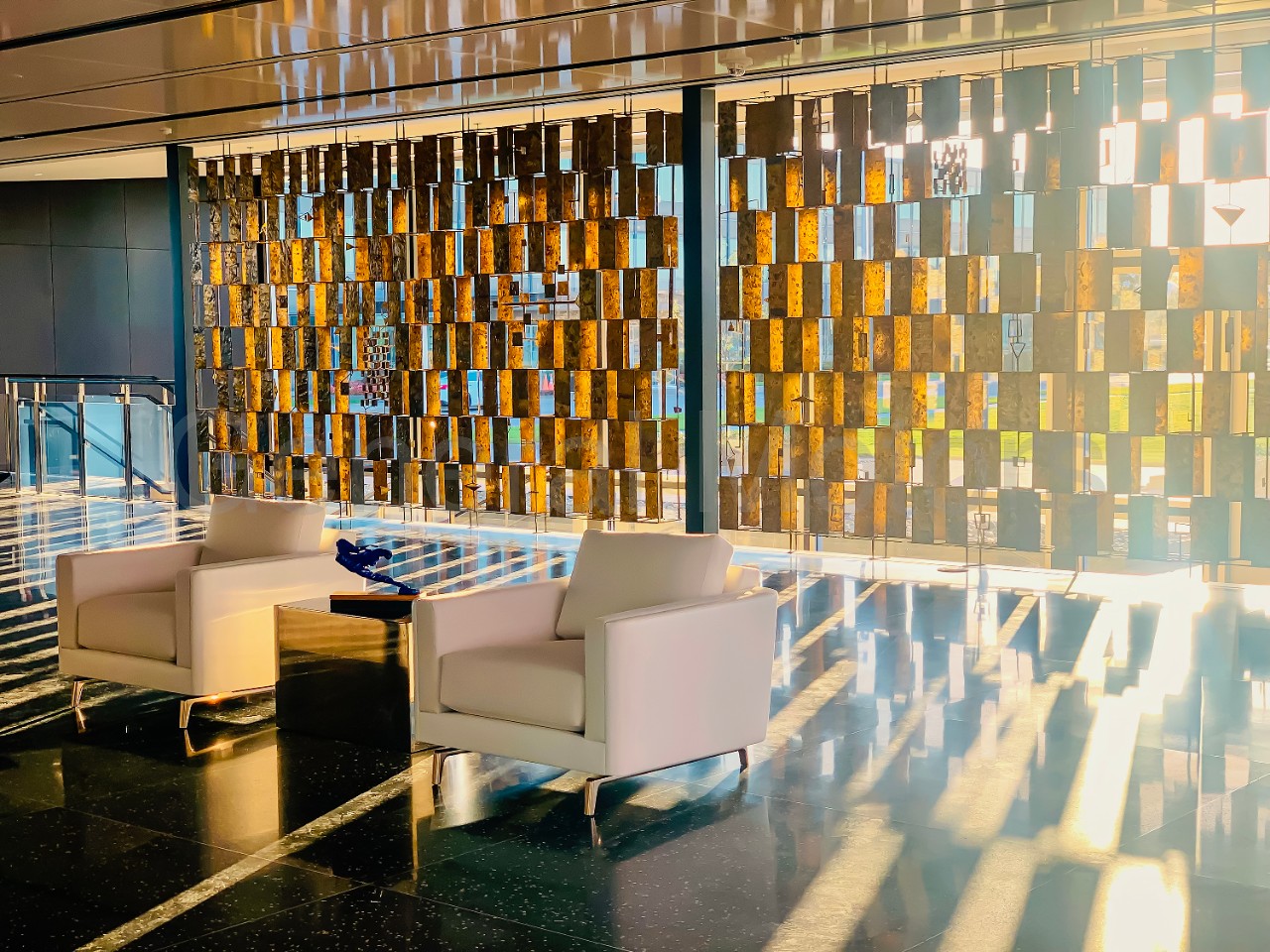
The Bertoia installation defined the entire western-facing wall of GM’s Central Restaurant – a building known today as the Cadillac House at Vanderbilt, where GM designers consult with clients to create each bespoke, individually-appointed CELESTIQ ultra-luxury sedan. This centerpiece earned Bertoia an Honor Award from the American Institute of Architects (AIA) in 1955, and was the first of more than 50 major public works completed by the artist during his lifetime.
In 1970, when Bertoia was an established leader in modernist sculpture, the J.L. Hudson Company commissioned an installation for the Genesee Valley Mall in Flint, Michigan. Bertoia’s creation was monumental in size, yet delicate in appearance: A 26-foot-tall sculpture that takes the form of two large clouds, constructed of steel wire coated in melted brass, bronze, and metal alloys.
In 1980, when the Genesee Valley Mall was shuttered for renovation, the Bertoia sculpture was moved to the Northland Mall in Southfield, Michigan. There, it vanished from public view for decades; when the Northland Mall was later demolished, it was feared that the Bertoia installation had been lost for good.
Miraculously, in 2017, appraisers from the Southfield Arts Commission discovered the lost Bertoia beneath layers of dirt in the basement of the demolished mall. The City of Southfield then purchased the artwork, and restoration was begun.
When General Motors announced its new headquarters on the site of the former J.L. Hudson’s department store on Woodward Avenue, the historic Detroit location provided the perfect home for the rediscovered Bertoia. Installing the heroic sculpture was a massive undertaking. A five-story-high opening had to be “unzipped” in the side of the Hudsons Detroit building. The sculpture was threaded through the 15-foot-wide, 75-foot-tall opening in two pieces, involving a complex ballet of chain-falls and cranes to safely transport the historic artwork.
With the lost Bertoia now permanently installed, the new GM headquarters at Hudsons Detroit showcases a work with deep connections to General Motors, to the city of Detroit, and to the midcentury arts movement that helped define the modern aesthetic.
“Having a Harry Bertoia sculpture in our new global headquarters in Hudson’s Detroit is incredibly meaningful,” said Crystal Windham, executive director of industrial design at General Motors. “Bertoia was a master at shaping metal, a principle that resonates deeply with our work in automotive design. His iconic screen at Cadillac House at Vanderbilt on our Global Technical Center campus is a legendary part of our design heritage. Now, this magnificent piece, with its own story of being lost and found, bridges GM’s past with our future. It serves as a daily inspiration, a powerful symbol of the creativity and resilience that has always defined both General Motors and the city of Detroit.”