
By: Chris Perkins, Senior Writer and Editor, GM News
How 92,000 virtual crash tests informed the design of the 2027 Chevrolet Silverado 1500
2026-11-16
By: Chris Perkins, Senior Writer and Editor, GM News
The moments before a crash test are filled with nervous excitement. From the observation room, you’re told to look at the barrier, rather than where the vehicle is coming from. Otherwise, you might miss it. After what sounds like a systems check before a rocket launch, dozens of lights come on, illuminating what’s about to happen. It’s a surreal scene for the uninitiated, but the product safety engineers working on the 2027 Chevrolet Silverado 1500 are confident.
Their confidence is well earned, too, as they know exactly what’s about to happen—they already tested it, virtually.
The test begins. It’s a particularly challenging one, a 40-percent frontal overlap, where the vehicle impacts a barrier at 40 percent of its width from the driver's side. A 50th percentile male dummy sits in the driver’s seat, while a 5th percentile female is behind in the back seat. A steel cable quickly pulls the Silverado up to 40 mph straight towards the barrier. Even though everyone knows what’s coming, the sound of the impact is still shocking, as is the stark silence that follows. It’s all over in a matter of seconds.
For decades, these sorts of crash tests were the cornerstone of safety engineering in passenger vehicles. In the early 1930s, GM engineers were the first in the automotive industry to intentionally crash vehicles to study what happened in a crash. Their research influenced vehicle design in an attempt to improve outcomes for occupants, other motorists, and pedestrians.
Today, physical crash tests are still of utmost importance, but the paradigm has shifted towards virtual engineering for occupant safety. The 2027 Silverado 1500 is emblematic of that shift.
Advancements in Computer-Aided Design (CAD), Computer-Aided Engineering (CAE), and simulation, have allowed safety engineers to do much of their work in a virtual space before performing real-world crash tests like this. Since physical crash testing is time-consuming and resource intensive—each requires a vehicle that, obviously, can’t be reused—virtual work gives engineers the opportunity to try out far more possibilities.
“GM is using math-based virtual engineering to run thousands of simulated crashes before physical properties exist,” says Regina Carto, GM Vice President, Global Product Safety, Systems and Certification. “Engineers can evaluate a much broader range of conditions—including different crash modes, occupant sizes, and seating positions. They can examine design details, identify issues earlier and iterate in weeks rather than months.”
While the 2027 Silverado 1500 was subject to dozens of physical crash tests throughout its development, engineers from the Global Safety Product Integration (GSPI) team performed about 92,000 virtual crash tests. Ultimately, around 80% of the safety engineering work for the 2027 Silverado was done in the virtual world, generating almost 2 petabytes of data in the process.
Physical crash testing is focused on the vehicle in its current form; virtual variation analysis helps GSPI engineers see how changing small variables can produce different results. They might look at things as granular as material thickness or how different components are joined together. These are things that may seem small, but can have a huge effect on the crash performance of the vehicle. After all, a passenger vehicle like a Silverado 1500 is made up of thousands of components, but in a crash, they all have to work as a system.
Variation analysis also allows engineers to evaluate a range of outcomes for a given scenario. It’s inevitable that there is variability in materials and manufacturing processes, and in the test itself. For this 40-mph, 40% frontal overlap test for the 2027 Silverado 1500, GSPI looked at hundreds of variations in how both the vehicle structure and the passenger restraint system would perform. These studies ultimately impact the final design of the vehicle.
It’s genuinely hard to comprehend all the data the GSPI team generates on a vehicle program like this. Two petabytes is equivalent to around 2.1 million gigabytes; to put it another way, around a trillion pages of text. Advanced AI is helping engineers make sense of these reams of possibilities, helping analyze more variations quickly and arrive at informed design decisions sooner. That’s critical in helping GM achieve its goal of halving vehicle development time from the current industry standard of 4-5 years.
Of course, AI isn’t replacing the human judgement of engineers. The GSPI team is there to interpret what AI is telling them, challenging its assumptions in the process of working towards a safe vehicle.
That brings us nicely back to this real-world crash test.
“Virtual engineering does not replace physical testing,” Carto says. “It makes physical testing more targeted, more efficient, and more informative. Virtual models help us explore more possibilities and refine the design; physical tests then confirm those results and help us improve the models. Together, these tools enable us to learn earlier in the process, and with greater fidelity to the real-world conditions our customers may face.”
It’s a never-ending feedback loop, with virtual engineering informing physical testing and vice versa.
“The GSPI team designs and analyzes crash performance with extraordinary precision—down to fractions of millimeters and milliseconds so we can help protect people in a collision. We strive for the best possible outcomes in the worst possible moments,” Carto says. “We hope customers never have to experience this work firsthand; no one gets into a vehicle expecting a crash. However, if one happens, we want them to be confident we’ve done the work to help protect them.”
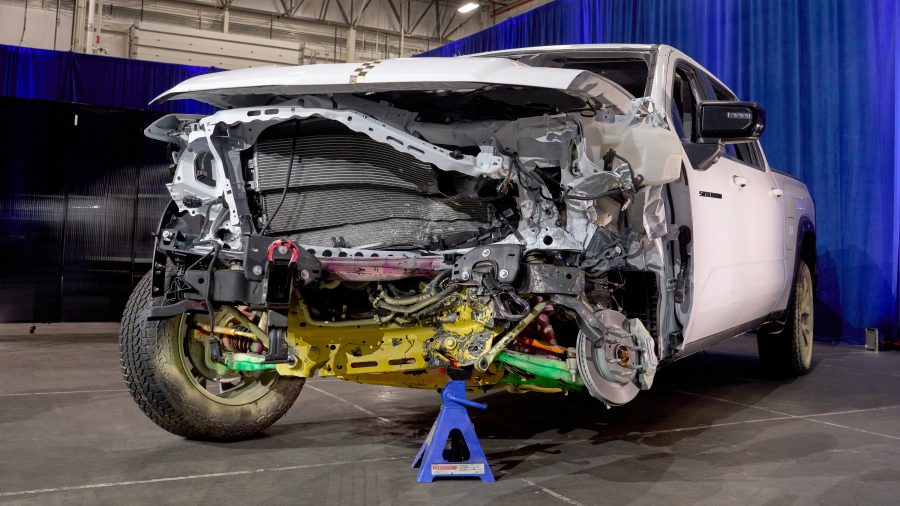
The moments before a crash test are filled with nervous excitement. From the observation room, you’re told to look at the barrier, rather than where the vehicle is coming from—otherwise, you might miss it. After what sounds like a systems check before a rocket launch, dozens of lights come on, illuminating what’s about to happen. It’s a surreal scene for the uninitiated, but the product safety engineers working on the 2027 Chevrolet Silverado 1500 are confident.
Their confidence is well earned, too, as they know exactly what’s about to happen—they already tested it, virtually.
The test begins. It’s a particularly challenging one, a 40% frontal overlap, where the vehicle impacts a barrier at 40 percent of its width from the driver's side. A 50th percentile male dummy sits in the driver’s seat, while a 5th percentile female is directly behind in the second-row seat. A steel cable quickly pulls the Silverado up to 40 mph straight towards the barrier. Even though everyone knows what’s coming, the sound of the impact is still shocking, as is the stark silence that follows. It’s all over in a matter of seconds.
For decades, these sorts of crash tests were the cornerstone of safety engineering in passenger vehicles. In the early 1930s, GM engineers were the first in the automotive industry to intentionally crash vehicles to study what happened in a crash. Their research influenced vehicle design in an attempt to improve outcomes for occupants, other motorists, and pedestrians.
Today, physical crash tests are still of utmost importance, but the paradigm has shifted towards virtual engineering for occupant safety. The 2027 Silverado 1500 is emblematic of that shift.
Advancements in Computer-Aided Design (CAD), Computer-Aided Engineering (CAE), and simulation, have allowed safety engineers to do much of their work in a virtual space before performing real-world crash tests like this. Since physical crash testing is time-consuming and resource intensive—each requires a vehicle that, obviously, can’t be reused—virtual work gives engineers the opportunity to try out far more possibilities, and earlier in development.
“GM is using math-based virtual engineering to run thousands of simulated crashes before physical properties exist,” says Regina Carto, GM Vice President, Global Product Safety, Systems and Certification. “Engineers can evaluate a much broader range of conditions—including different crash modes, occupant sizes, and seating positions. They can examine design details, identify issues earlier and iterate in weeks rather than months.”
While the 2027 Silverado 1500 was subjected to multiple physical crash tests throughout its development, engineers from the Global Safety Product Integration (GSPI) team performed about 92,000 virtual crash tests. Ultimately, around 80% of the passive safety engineering work for the 2027 Silverado was done in the virtual world, generating almost 2 petabytes of data in the process.
Physical crash testing is focused on the vehicle in its current form; virtual variation analysis helps GSPI engineers see how changing small variables can produce different results. They might look at things as granular as material thickness or how different components are joined together. These are things that may seem small, but can have a huge effect on the crash performance of the vehicle. After all, a vehicle like a Silverado 1500 is made up of thousands of components, but in a crash, they all have to work as a system.
Variation analysis also allows engineers to evaluate a range of outcomes for a given scenario. It’s inevitable that there is variability in materials and manufacturing processes, and in the test itself. For this 40-mph, 40% frontal overlap test for the 2027 Silverado 1500, GSPI looked at hundreds of variations in how both the vehicle structure and the passenger restraint system would perform. These studies ultimately impact the final design of the vehicle.
It’s genuinely hard to comprehend all the data the GSPI team generates on a vehicle program like this. Two petabytes is equivalent to around 2.1 million gigabytes; to put it another way, around a trillion pages of text. Advanced AI will help engineers make sense of these reams of possibilities, helping analyze more variations quickly and arrive at informed design decisions sooner. That’s critical in helping GM achieve its goal of halving vehicle development time from the current industry standard of 4-5 years.
AI assists the engineers in processing data, debugging models, and in the near future, assisting with many other repetitive tasks.
That brings us nicely back to this real-world crash test.
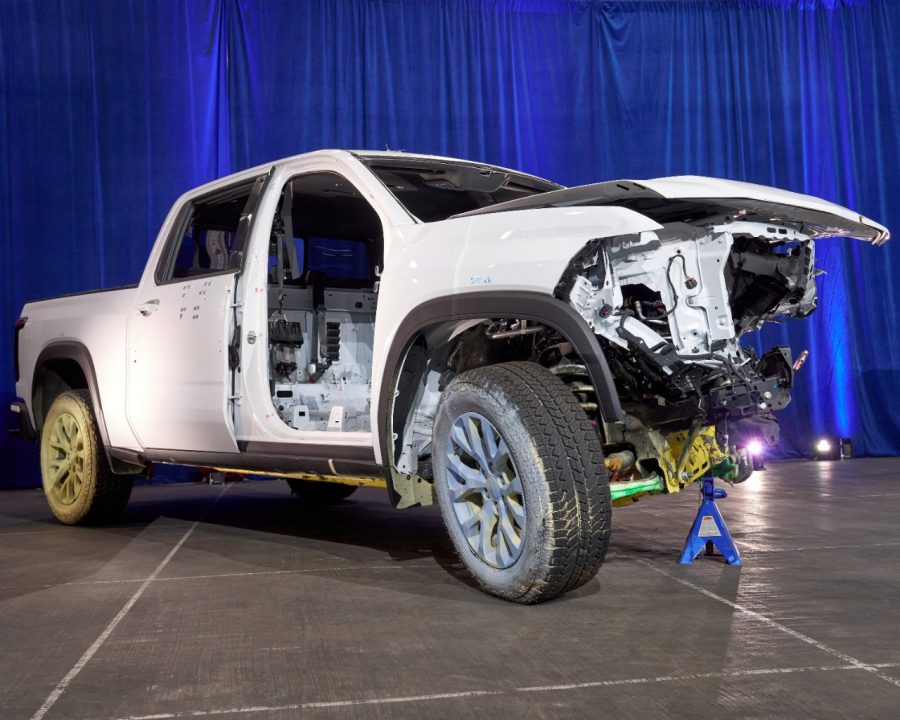
“Virtual engineering makes our physical testing more targeted, more efficient, and more informative,” Carto says. “Virtual models help us explore more possibilities and refine the design; physical tests then confirm those results and help us improve the models. Together, these tools enable us to learn earlier in the process, and with greater fidelity to the real-world conditions our customers may face.”
It’s a never-ending feedback loop, with virtual engineering informing physical testing and vice versa.
“The GSPI team designs and analyzes crash performance with extraordinary precision—down to fractions of millimeters and milliseconds so we can help protect people in a collision,” Carto says. “We hope customers never have to experience this work firsthand; no one gets into a vehicle expecting a crash. However, if one happens, we want them to be confident we’ve done the work to help protect them. We strive for the best possible outcomes in the worst possible moments.”