
By Stephen Harber, content strategist, talent marketing
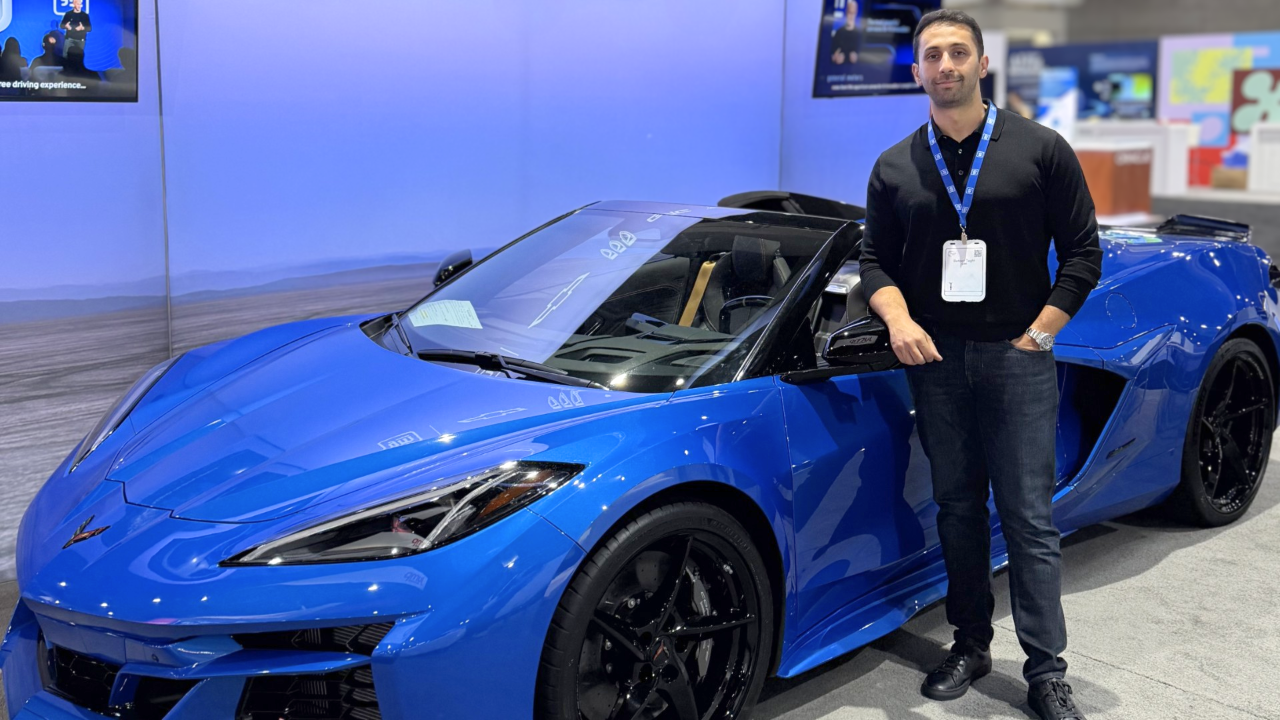
AI & Robotics Lead Dr. Behrad Toghi with a Chevrolet Corvette E-Ray at NeurIPS 2025.
By Stephen Harber, content strategist, talent marketing
At the NeurIPS 2025 AI conference in San Diego, General Motors participated in the core technical conversations shaping applied AI for the physical world.
Across autonomy and robotics, GM teams spent the week in detailed discussions with researchers on how advanced AI is engineered into working systems. The emphasis was practical: building systems that operate under real-world constraints and perform at scale.
Here’s an overview of GM’s impact at NeurIPS 2025.
Autonomy in Real Traffic
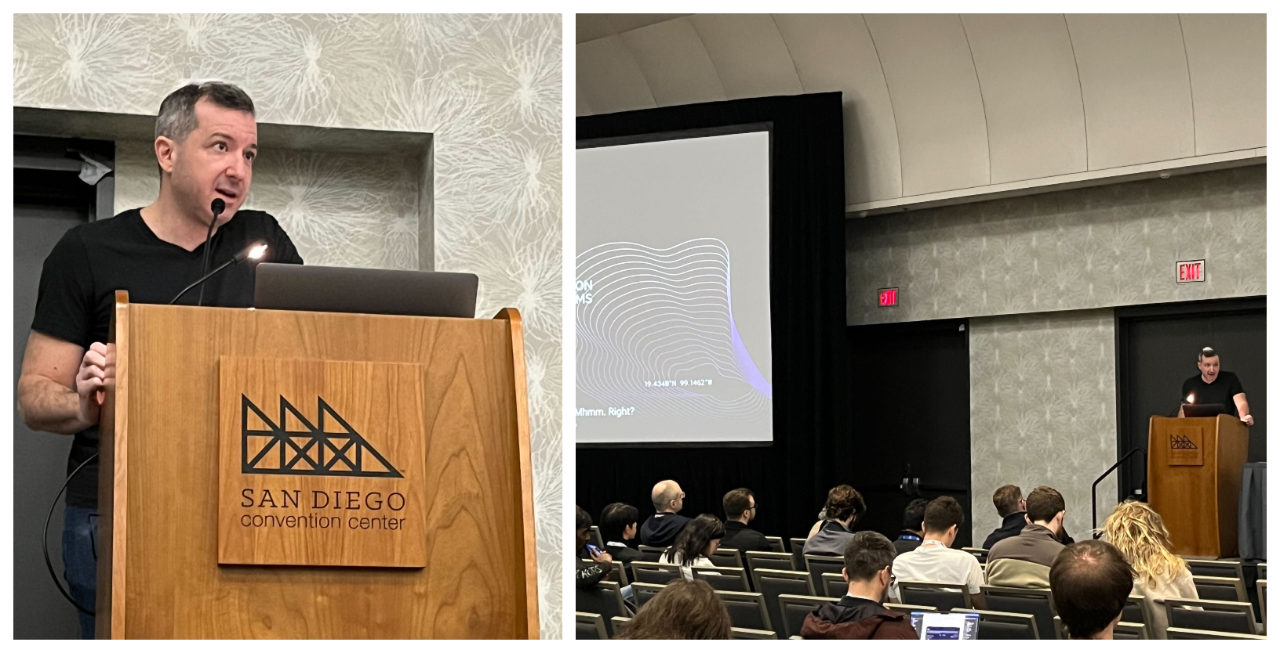
Ben Snyder, Director of Autonomous Vehicle Research at GM, opened the conference by framing autonomy as both an AI and a systems challenge shaped by behavior, safety, and scale.
Snyder focused on how autonomy behaves under real driving conditions and safety constraints, rather than just demonstrations. His remarks reflected GM’s focus on building AI that performs beyond controlled settings and into everyday use.
This framing set the tone for the rest of the event. Autonomy was no longer abstract — it was operational.
Watch his speech on the NeurIPS 2025 website.
GM’s Director of AI Research Ben Snyder navigates open research challenges in scalable self-driving during his expo talk.
AI in Production Environments
This throughline continued on stage in the session Practical AI for the Physical World.
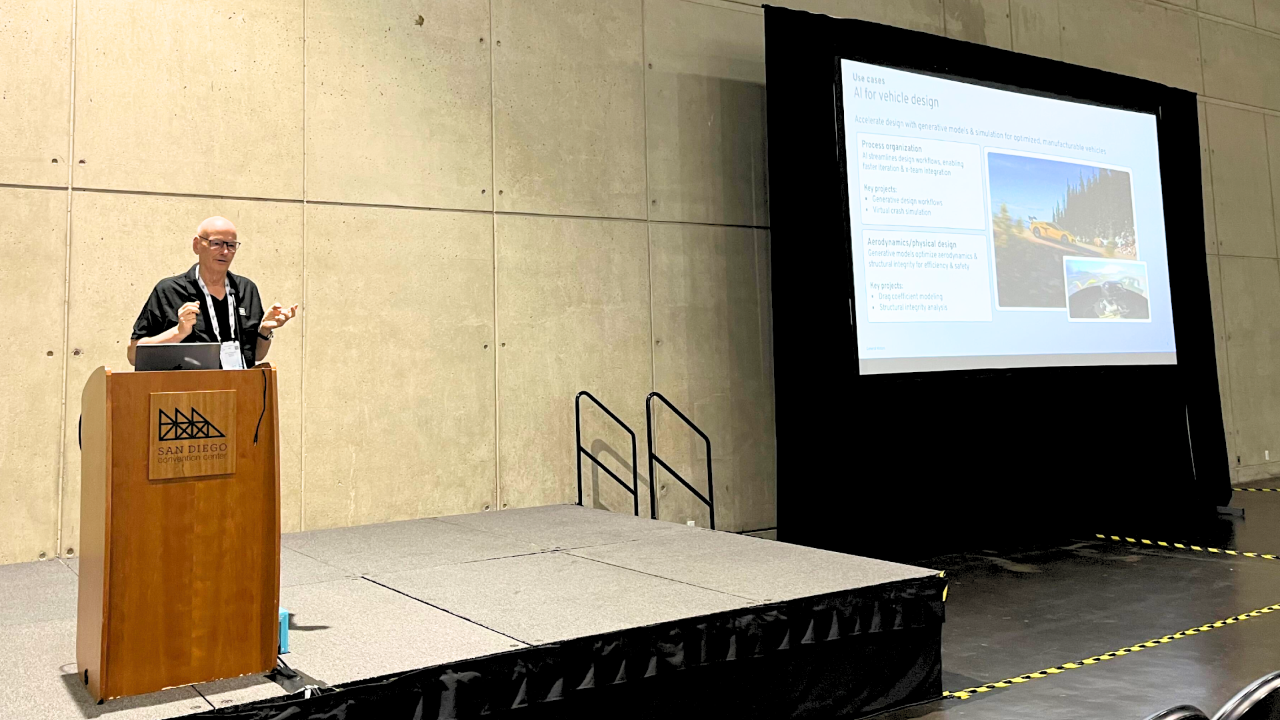
John Anderson, Executive Director of AI Research at GM, joined Davey Weissberg, Director of AI Product Management at GM to discuss how AI is being used in robotics and manufacturing, where systems are expected to work the first time and every time.
“I gave a speech which focused on explaining GM’s interest in AI outside of autonomous vehicles,” Anderson said. “This included AI-based understanding of physical systems, as well as using AI to scale collaborative robots for improved safety and ergonomics. ”
The discussion stayed grounded in one priority: getting AI to perform in production settings, not just in controlled trials.
Robotics Took Center Stage
By midweek, robotics had overtaken many of the expected headline topics at NeurIPS.
“Robotics was prominent in many of the discussions,” Anderson added. “I had expected much more focus on large language models and AGI. But robotics was everywhere.”
For GM, the signal was clear. The research community was increasingly focused on physical interaction and operational complexity — the same challenges GM teams are already engineering against.
John Anderson, Executive Director of AI Research at GM, discusses the benefits of robotics in manufacturing to a full crowd.
At the Booth: From Interest to Implementation
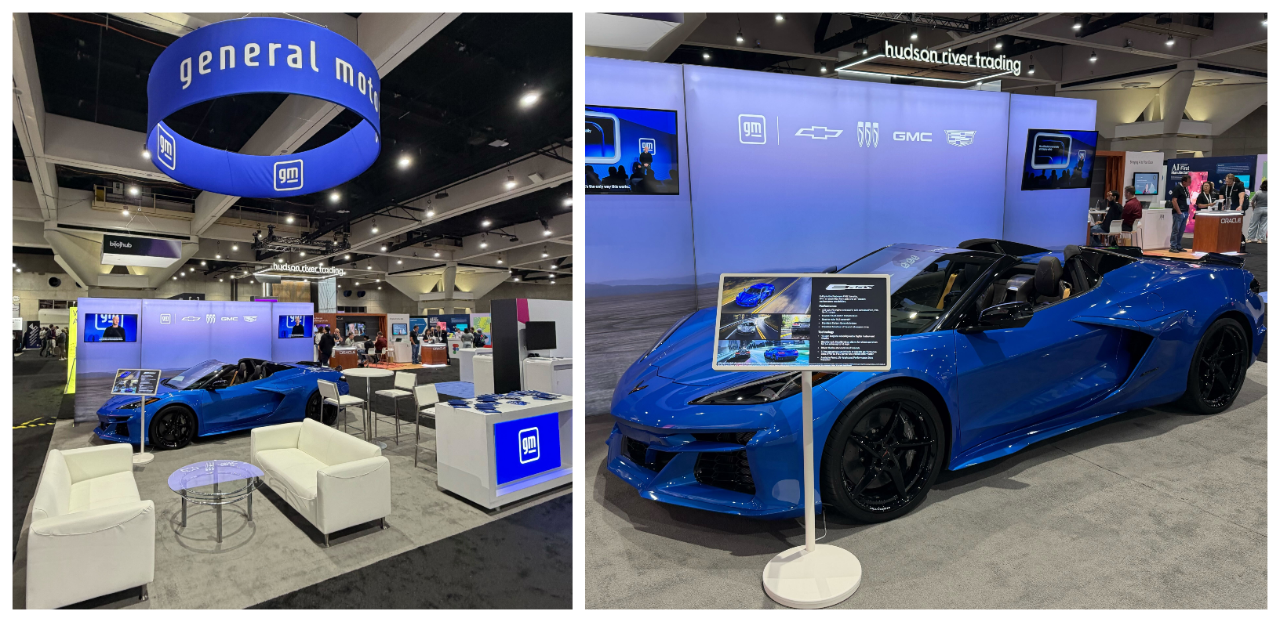
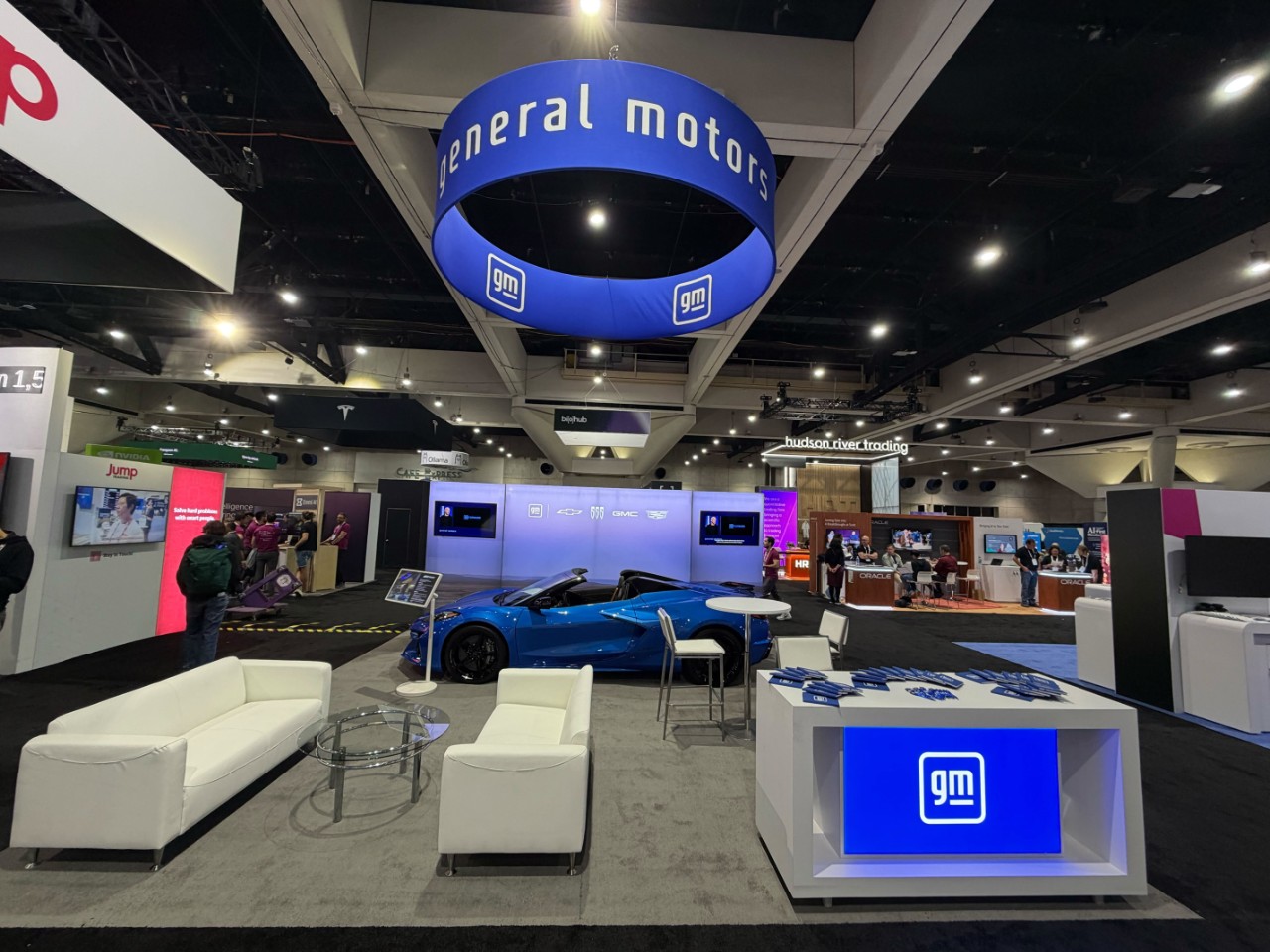
The effect was immediate at the GM booth. Attendees began asking detailed questions about autonomy, robotics, and learning at scale. What began as casual interest turned into focused technical discussion. And the Chevy Corvette C8 E-Ray was a great conversation starter.
“First they asked, ‘Can I drive the car?’” Anderson said. “Then they asked what GM’s interest in the NeurIPS research community was. It was great to talk with them about our projects in AV and other spaces.”
The questions moved fast. Many wanted to understand how GM is taking research ideas and turning them into deployed capability.
GM’s event booth at NeurIPS, featuring the Chevrolet Corvette C8 E-Ray.
Where Applied AI Met the C-Suite
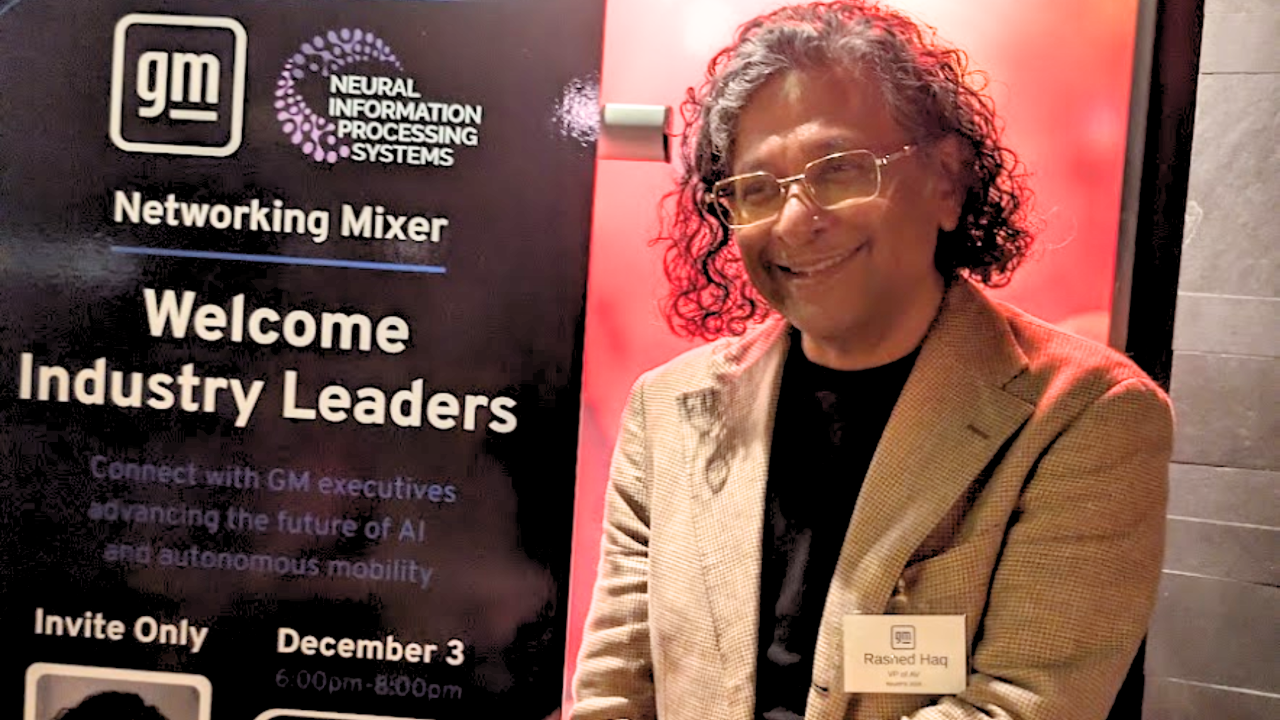
Day one concluded with GM’s Executive Mixer, hosted by Vice President of Autonomy Rashed Haq, bringing together researchers, engineers, and industry leaders for focused discussion on where applied AI is headed.
The themes mirrored what had surfaced throughout the day. There was strong interest in reinforcement learning beyond pre-training, along with growing attention to reasoning under compute constraints. Evaluation remained a central concern as systems move closer to deployment.
“There was much more focus on going beyond LLM and VLM pre-training,” Haq said. “We saw more discussion on reinforcement learning for fine-tuning, efficient reasoning, and better evaluation. That reflects where real-world deployment is pushing the field.”
GM’s VP of Autonomy Rashed Haq celebrates an evening of networking, insights, and refreshments at our invite-only Executive Mixer event.
For Haq, GM’s presence at NeurIPS was about staying closely engaged with the research community as the industry advances toward large-scale autonomous systems and next-generation robotics.
The mixer extended those exchanges beyond the stage and the booth, strengthening connections with the researchers shaping the next phase of the field.
When Researchers Saw What GM Is Building
That engagement continued in direct technical exchange with emerging researchers across the conference.
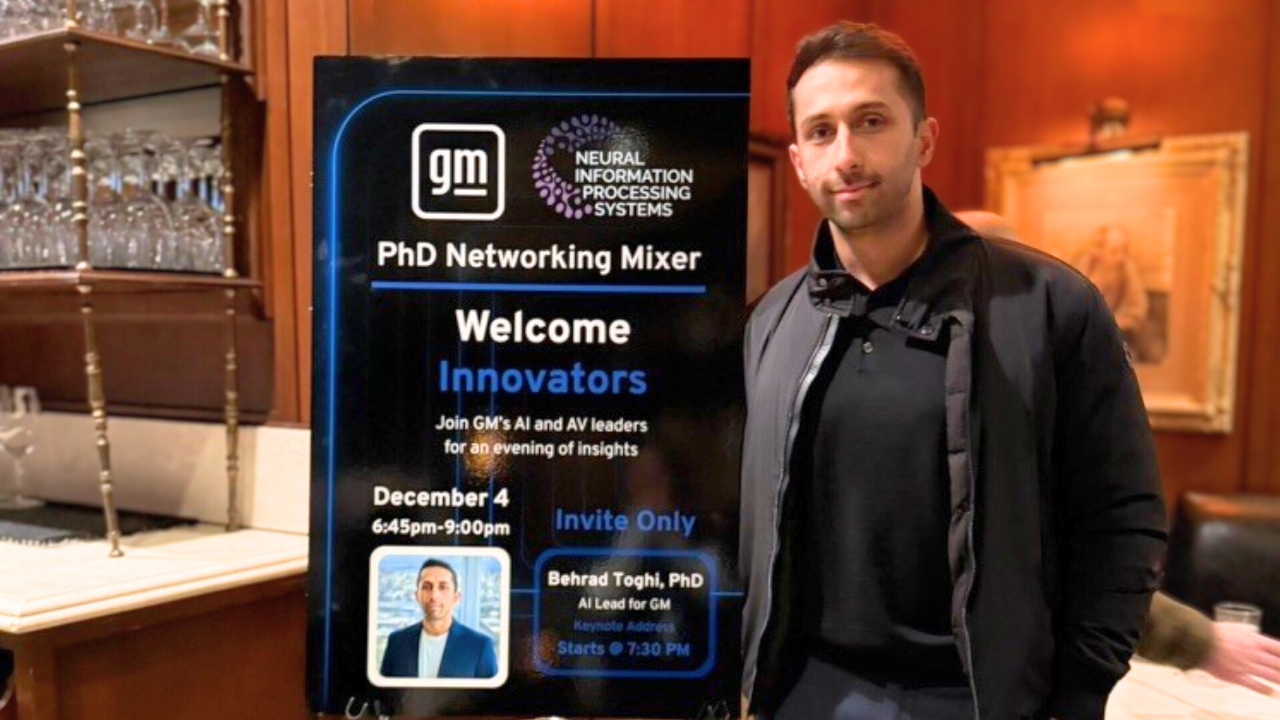
A focal point was GM’s PhD Mixer, where doctoral candidates and GM leaders discussed applied AI and real-world deployment. The emphasis was on substance. Attendees wanted to understand what problems GM teams are solving and how research becomes production work in autonomy and robotics.
AI & Robotics Lead Dr. Behrad Toghi prepares for his keynote speech at GM’s exclusive PhD Mixer event.
Dr. Behrad Toghi, AI & Robotics Lead at GM, spoke during the mixer and spent time with researchers throughout the event.
“Everyone knows GM for our cars and trucks. As the world starts to hear of our progress in areas like AI and robotics, and the massive impact that tech can have, there is a lot of enthusiasm,” Dr. Toghi said. “I enjoyed the conversations around areas like world models, reinforcement learning, evaluation, and sharing where GM teams are actively building.”
Those discussions moved quickly into areas like world models, reinforcement learning, and evaluation — the same areas GM teams are actively building.
Watch Dr. Behrad Toghi’s keynote from the PhD Mixer on the NeurIPS 2025 website.
Why NeurIPS 2025 Mattered for GM
NeurIPS 2025 underscored the pace and volume of new work emerging across the field.
“The quantity of new work was impossible to really comprehend,” John Anderson said. “When I walked into the poster hall it was like the scene at the end of Raiders of the Lost Ark in the warehouse. It will probably require AI tools just to understand which papers matter most.”
That scale only reinforced why GM’s participation mattered. “I think GM being at NeurIPS is an important step in engaging with the broader AI research community,” Anderson said.
A full display of GM’s booth at NeurIPS 2025: where AI, robotics, and the future of transportation intersect.
Rashed Haq saw the same momentum from another angle. At a dinner with Terry Sejnowski, president of the NeurIPS Foundation, he learned that 2025 marked the conference’s largest attendance yet, with more than 25,000 participants.
“We’ve come a long way from my first NeurIPS, when fewer than a thousand people were there and that felt huge,” Haq said.
This growth reflects the expanding role of AI across industries. “Conferences like this are vital to our progress as we work toward fully driverless autonomy,” Haq added. “Many of the lessons here extend across physical AI and robotics as well.”
NeurIPS 2025 was about staying in step with the work that defines how AI will operate in the real world.
At the NeurIPS 2025 AI conference in San Diego, General Motors participated in the core technical conversations shaping applied AI for the physical world.
Across autonomy and robotics, GM teams spent the week in detailed discussions with researchers on how advanced AI is engineered into working systems. The emphasis was practical: building systems that operate under real-world constraints and perform at scale.
Here’s an overview of GM’s impact at NeurIPS 2025.
Autonomy in Real Traffic
Ben Snyder, Director of Autonomous Vehicle Research at GM, opened the conference by framing autonomy as both an AI and a systems challenge shaped by behavior, safety, and scale.
Snyder focused on how autonomy behaves under real driving conditions and safety constraints, rather than just demonstrations. His remarks reflected GM’s focus on building AI that performs beyond controlled settings and into everyday use.
This framing set the tone for the rest of the event. Autonomy was no longer abstract — it was operational.
Watch his speech on the NeurIPS 2025 website.
AI in Production Environments
This throughline continued on stage in the session Practical AI for the Physical World.
John Anderson, Executive Director of AI Research at GM, joined Davey Weissberg, Director of AI Product Management at GM to discuss how AI is being used in robotics and manufacturing, where systems are expected to work the first time and every time.
“I gave a speech which focused on explaining GM’s interest in AI outside of autonomous vehicles,” Anderson said. “This included AI-based understanding of physical systems, as well as using AI to scale collaborative robots for improved safety and ergonomics.”
The discussion stayed grounded in one priority: getting AI to perform in production settings, not just in controlled trials.
Robotics Took Center Stage
By midweek, robotics had overtaken many of the expected headline topics at NeurIPS.
“Robotics was prominent in many of the discussions,” Anderson added. “I had expected much more focus on large language models and AGI. But robotics was everywhere.”
For GM, the signal was clear. The research community was increasingly focused on physical interaction and operational complexity — the same challenges GM teams are already engineering against.
At the Booth: From Interest to Implementation
The effect was immediate at the GM booth. Attendees began asking detailed questions about autonomy, robotics, and learning at scale. What began as casual interest turned into focused technical discussion. And the Chevy Corvette C8 E-Ray was a great conversation starter.
“First they asked, ‘Can I drive the car?’” Anderson said. “Then they asked what GM’s interest in the NeurIPS research community was. It was great to talk with them about our projects in AV and other spaces.”
The questions moved fast. Many wanted to understand how GM is taking research ideas and turning them into deployed capability.
Where Applied AI Met the C-Suite
Day one concluded with GM’s Executive Mixer, hosted by Vice President of Autonomy Rashed Haq, bringing together researchers, engineers, and industry leaders for focused discussion on where applied AI is headed.
The themes mirrored what had surfaced throughout the day. There was strong interest in reinforcement learning beyond pre-training, along with growing attention to reasoning under compute constraints. Evaluation remained a central concern as systems move closer to deployment.
“There was much more focus on going beyond LLM and VLM pre-training,” Haq said. “We saw more discussion on reinforcement learning for fine-tuning, efficient reasoning, and better evaluation. That reflects where real-world deployment is pushing the field.”
For Haq, GM’s presence at NeurIPS was about staying closely engaged with the research community as the industry advances toward large-scale autonomous systems and next-generation robotics.
The mixer extended those exchanges beyond the stage and the booth, strengthening connections with the researchers shaping the next phase of the field.
When Researchers Saw What GM Is Building
That engagement continued in direct technical exchange with emerging researchers across the conference.
A focal point was GM’s PhD Mixer, where doctoral candidates and GM leaders discussed applied AI and real-world deployment. The emphasis was on substance. Attendees wanted to understand what problems GM teams are solving and how research becomes production work in autonomy and robotics.
Dr. Behrad Toghi, AI & Robotics Lead at GM, spoke during the mixer and spent time with researchers throughout the event.
“Everyone knows GM for our cars and trucks. As the world starts to hear of our progress in areas like AI and robotics, and the massive impact that tech can have, there is a lot of enthusiasm,” Dr. Toghi said. “I enjoyed the conversations around areas like world models, reinforcement learning, evaluation, and sharing where GM teams are actively building.”
Those discussions moved quickly into areas like world models, reinforcement learning, and evaluation — the same areas GM teams are actively building.
Watch Dr. Behrad Toghi’s keynote from the PhD Mixer on the NeurIPS 2025 website.
Why NeurIPS 2025 Mattered for GM
NeurIPS 2025 underscored the pace and volume of new work emerging across the field.
“The quantity of new work was impossible to really comprehend,” John Anderson said. “When I walked into the poster hall it was like the scene at the end of Raiders of the Lost Ark in the warehouse. It will probably require AI tools just to understand which papers matter most.”
That scale only reinforced why GM’s participation mattered. “I think GM being at NeurIPS is an important step in engaging with the broader AI research community,” Anderson said.
Rashed Haq saw the same momentum from another angle. At a dinner with Terry Sejnowski, president of the NeurIPS Foundation, he learned that 2025 marked the conference’s largest attendance yet, with more than 25,000 participants.
“We’ve come a long way from my first NeurIPS, when fewer than a thousand people were there and that felt huge,” Haq said.
This growth reflects the expanding role of AI across industries. “Conferences like this are vital to our progress as we work toward fully driverless autonomy,” Haq added. “Many of the lessons here extend across physical AI and robotics as well.”
NeurIPS 2025 was about staying in step with the work that defines how AI will operate in the real world.