
By: Chris Perkins, writer and editor, GM News, and Rita Kass-Shamoun, GM Energy Communicatons
By: Chris Perkins, writer and editor, GM News
An electric vehicle can be more than just a way to get you where you need to be. Whether through vehicle-to-load or vehicle-to-home capability, GM employees are unlocking more from their Chevrolet, GMC, and Cadillac EVs.
Vehicle-to-Load (Offboard Power) is a feature that allows an EV to power external devices, tools, or equipment from the battery through outlets built into the vehicle.
Andrew Ertley, lead counsel for GM Defense, used his GMC Sierra Denali EV to provide power to a recent PTA fundraiser for his kids’ school. Held across two family backyards on a Fall evening, the event didn't have a way to power the lighting. Enter the Sierra Denali EV. Ertley’s truck is equipped with the GMC Power Station Pro, which can deliver up to 10.2 kilowatts of offboard power, more than enough to handle the lighting for the event.
“Guests enjoyed a well-lit, safe environment with no extension cords creating a tripping hazard,” Ertley says. “The fundraiser was a resounding success, raising over $40,000 to support school programs and initiatives.”
Illuminating the PTA fundraiser used just 2% of the Sierra EV’s battery charge and proved that this truck could be more than just a means of transportation.
“GM’s advanced technology didn’t just power lights, it powered community spirit,” Ertley adds.
Carolyn Bollozos’ Chevrolet Blazer EV in her home garage.
Vehicle-to-Home (V2H) is a bidirectional charging capability that allows a V2H-capable GM EV to send power from its battery back into a properly equipped home, helping to provide power to appliances or home essentials during outages. This capability requires dedicated GM Energy V2H equipment to safely manage, convert, and control the energy flow.
For Carolyn Bollozos, power outages are just a fact of life. She estimates her home loses power at least a half-dozen times a year.
Carolyn Bollozos’ GM Energy Home System.
Enough was enough, but as Finance Manager for GM Energy, Bollozos was uniquely familiar with the ideal solution. For her home, Bollozos purchased a GM Energy Home System. This consists of a GM Energy PowerShift charger, a 35.4-kWh GM Energy PowerBank, and a Home Hub and Inverter to control the whole system.
“We invested in a GM Energy Home System as customers,” Bollozos says. “I work in GM Energy, but the decision was really to tap into the potential of my EV and keep my house powered during outages. I’ve got young kids and I want to keep them safe when it’s 0 degrees, or when it’s 100 degrees.”
Perhaps unsurprisingly, not long after installation, her family got to put the system to use.
“We had one of those very cold, windy days, and the power went out,” she says. “Like a good Michigander, I said ‘Ope! The power is out’ and within seconds, all the lights kicked back on. No noise, no real hesitation, no disruption.”
Her GM Energy system kept her home essentials powered for over seven hours that day. In a fun bit of irony, Bollozos was working from home, so her GM Energy system allowed her to get back to her work for GM Energy.
Though she was excited to put the system to the test, GM Energy made this power outage a non-event for Bollozos and her family, which is the point.
Jim Reilly’s GMC Sierra EV and GM Energy Power Bank.
Vehicle-to-Home (V2H) + Solar refers to integrating a V2H-capable GM EV, compatible solar panels, and GM Energy V2H equipment to manage energy flow between the vehicle, the home, and onsite solar generation — enabling home backup power, increased solar consumption, and household energy management.
Jim Reilly, Group Manager of Portfolio Planning at GM Energy has solar on the roof of his Seattle home, a GM Energy PowerShift charger for his and his wife’s GM EVs, a 10.6-kWh GM Energy PowerBank, and a Home Hub and Inverter.
Jim Reilly’s solar panels.
Seattle skies are frequently gray, so Reilly uses his GM Energy PowerBank to store solar energy whenever his panels can capture it for later use. He was able to use the system during a neighborhood-wide power outage over the holidays.
“People were coming to visit and every electrical appliance in our house was running,” Reilly says. “I asked my wife if we could slow down using our appliances to preserve energy. She totally forgot the power was out.”
Later, Reilly and his wife walked through their neighborhood, listening to the hum of gas-powered generators. Their driveway was notable for its silence.
Vehicle-to-Grid (V2G) technology will allow GM EVs to supply power back to the grid. In the future, select GM EVs may offer utilities an opportunity to enhance grid resilience and help to manage growing energy demand.
A Chevrolet, GMC, or Cadillac EV is, of course, a wonderful means of transportation. The very same battery that gets owners from point A to point B, has the potential to save day. GM Energy exists to tap into that potential, and employees are already reaping the benefits.
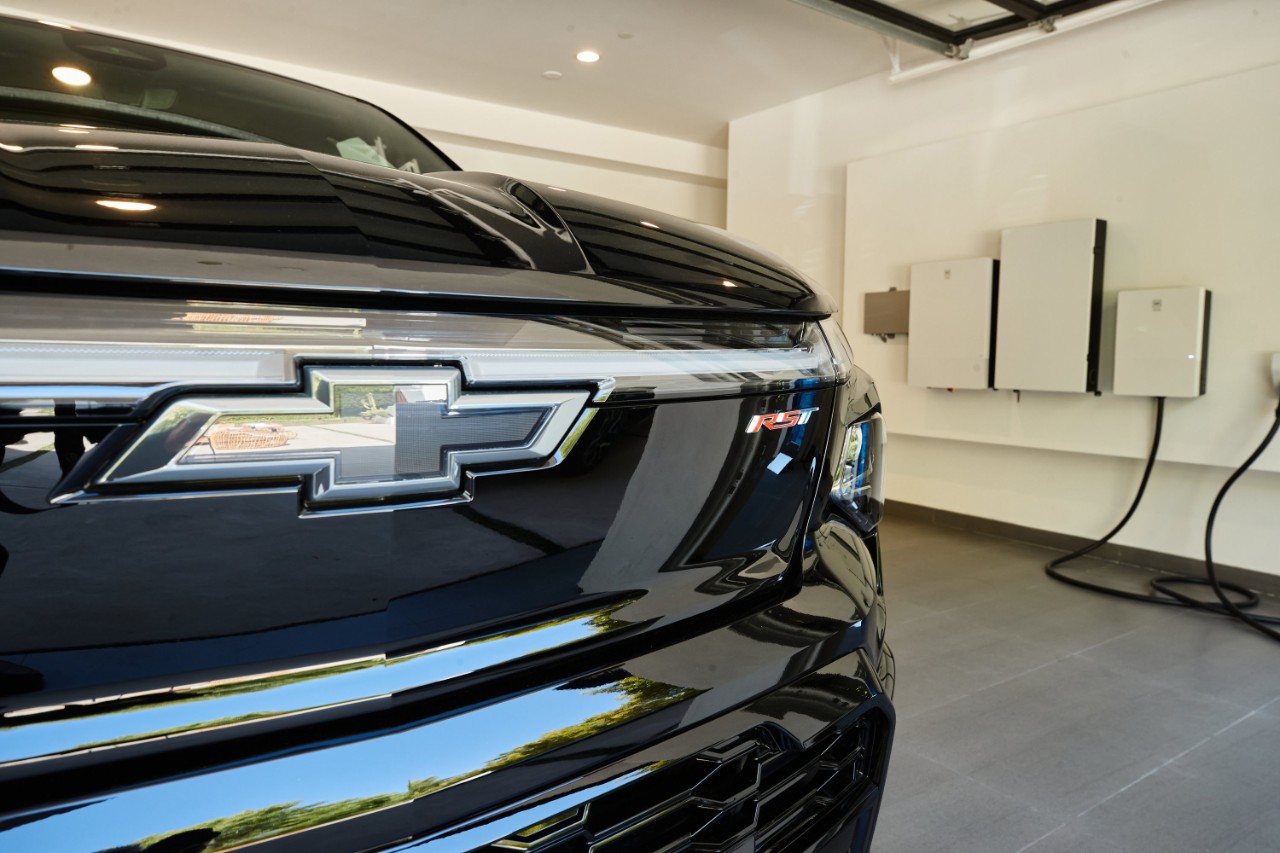
An electric vehicle can be more than just a way to get you where you need to be. Whether through vehicle-to-load or vehicle-to-home capability, GM employees are unlocking more from their Chevrolet, GMC, and Cadillac EVs.
Vehicle-to-Load (Offboard Power) is a feature that allows an EV to power external devices, tools, or equipment from the battery through outlets built into the vehicle.
Andrew Ertley, lead counsel for GM Defense, used his GMC Sierra Denali EV to provide power to a recent PTA fundraiser for his kids’ school. Held across two family backyards on a Fall evening, the event didn't have a way to power the lighting. Enter the Sierra Denali EV. Ertley’s truck is equipped with the GMC Power Station Pro, which can deliver up to 10.2 kilowatts of offboard power, more than enough to handle the lighting for the event.
“Guests enjoyed a well-lit, safe environment with no extension cords creating a tripping hazard,” Ertley says. “The fundraiser was a resounding success, raising over $40,000 to support school programs and initiatives.”
Illuminating the PTA fundraiser used just 2% of the Sierra EV’s battery charge and proved that this truck could be more than just a means of transportation.
“GM’s advanced technology didn’t just power lights, it powered community spirit,” Ertley adds.
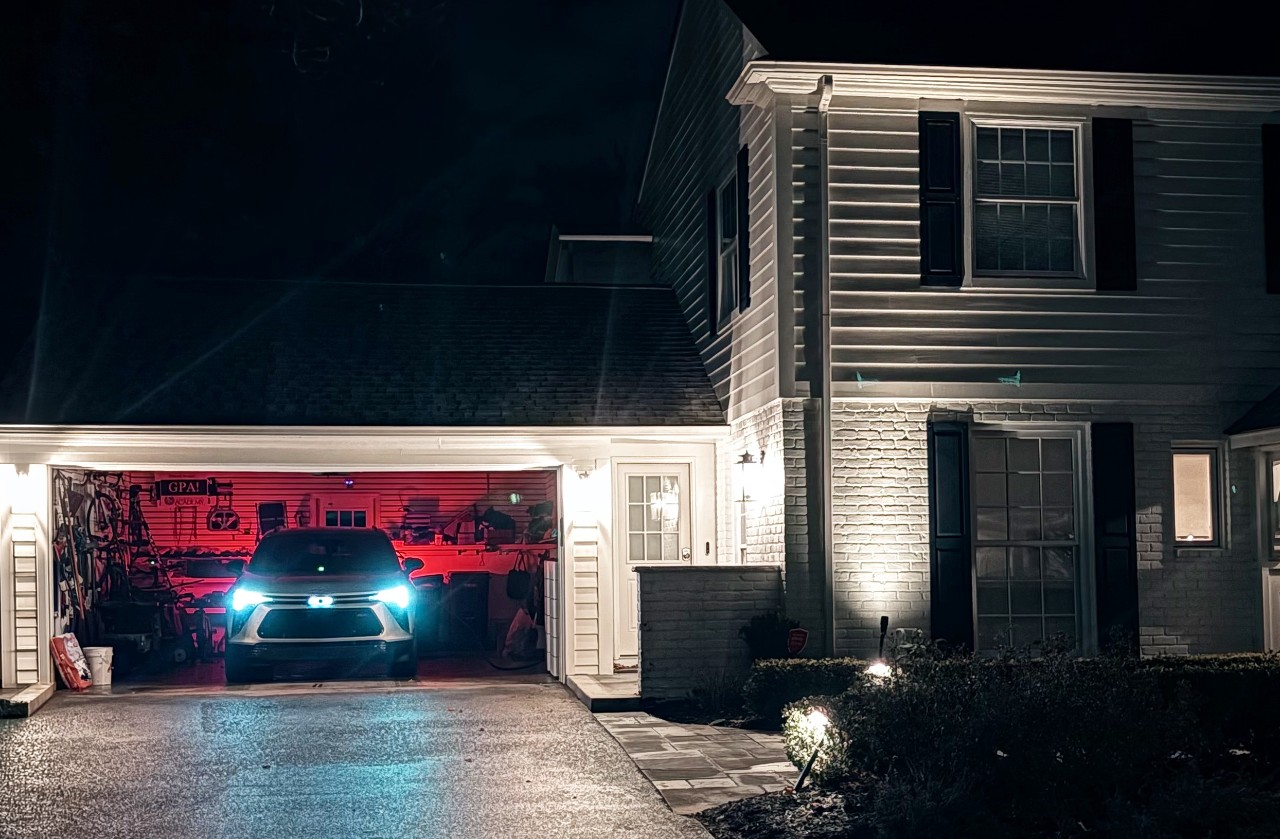
Vehicle-to-Home (V2H) is a bidirectional charging capability that allows a V2H-capable GM EV to send power from its battery back into a properly equipped home, helping to provide power to appliances or home essentials during outages. This capability requires dedicated GM Energy V2H equipment to safely manage, convert, and control the energy flow.
For Carolyn Bollozos, power outages are just a fact of life. She estimates her home loses power at least a half-dozen times a year.
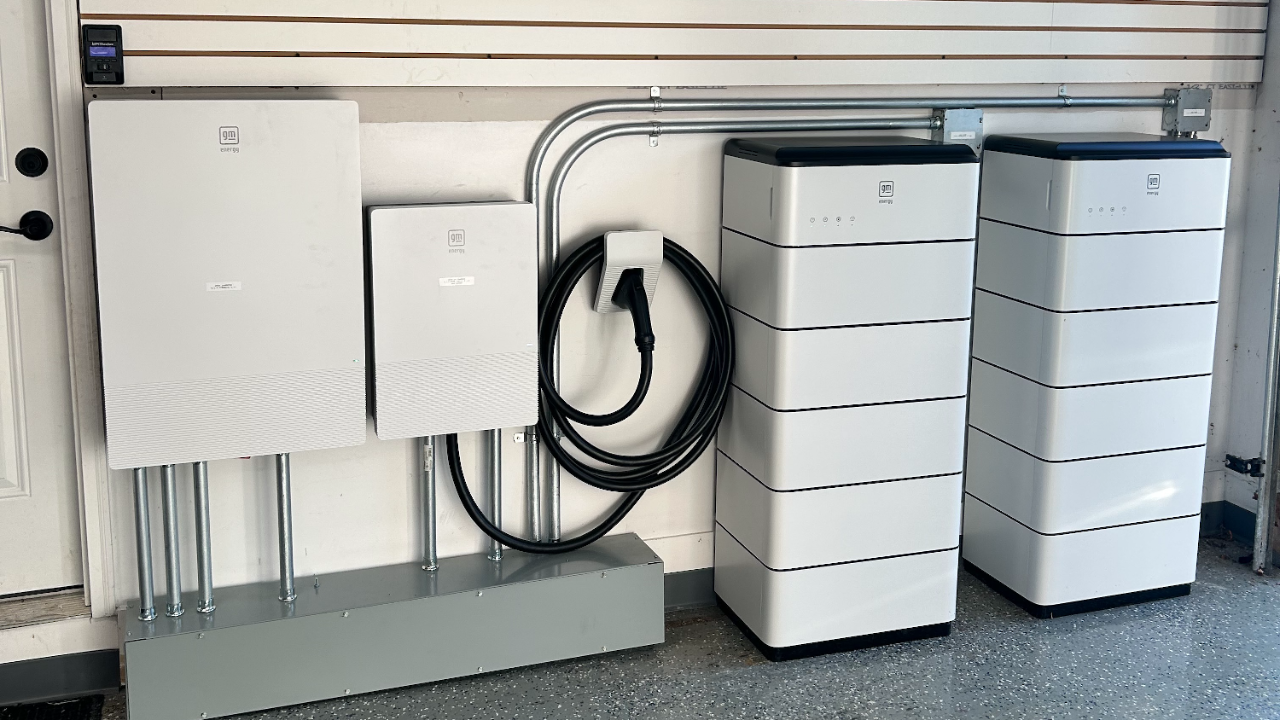
Enough was enough, but as Finance Manager for GM Energy, Bollozos was uniquely familiar with the ideal solution. For her home, Bollozos purchased a GM Energy Home System. This consists of a GM Energy PowerShift charger, a 35.4-kWh GM Energy PowerBank, and a Home Hub and Inverter to control the whole system.
“We invested in a GM Energy Home System as customers,” Bollozos says. “I work in GM Energy, but the decision was really to tap into the potential of my EV and keep my house powered during outages. I’ve got young kids and I want to keep them safe when it’s 0 degrees, or when it’s 100 degrees.”
Perhaps unsurprisingly, not long after installation, her family got to put the system to use.
“We had one of those very cold, windy days, and the power went out,” she says. “Like a good Michigander, I said ‘Ope! The power is out’ and within seconds, all the lights kicked back on. No noise, no real hesitation, no disruption.”
Her GM Energy system kept her home essentials powered for over seven hours that day. In a fun bit of irony, Bollozos was working from home, so her GM Energy system allowed her to get back to her work for GM Energy.
Though she was excited to put the system to the test, GM Energy made this power outage a non-event for Bollozos and her family, which is the point.
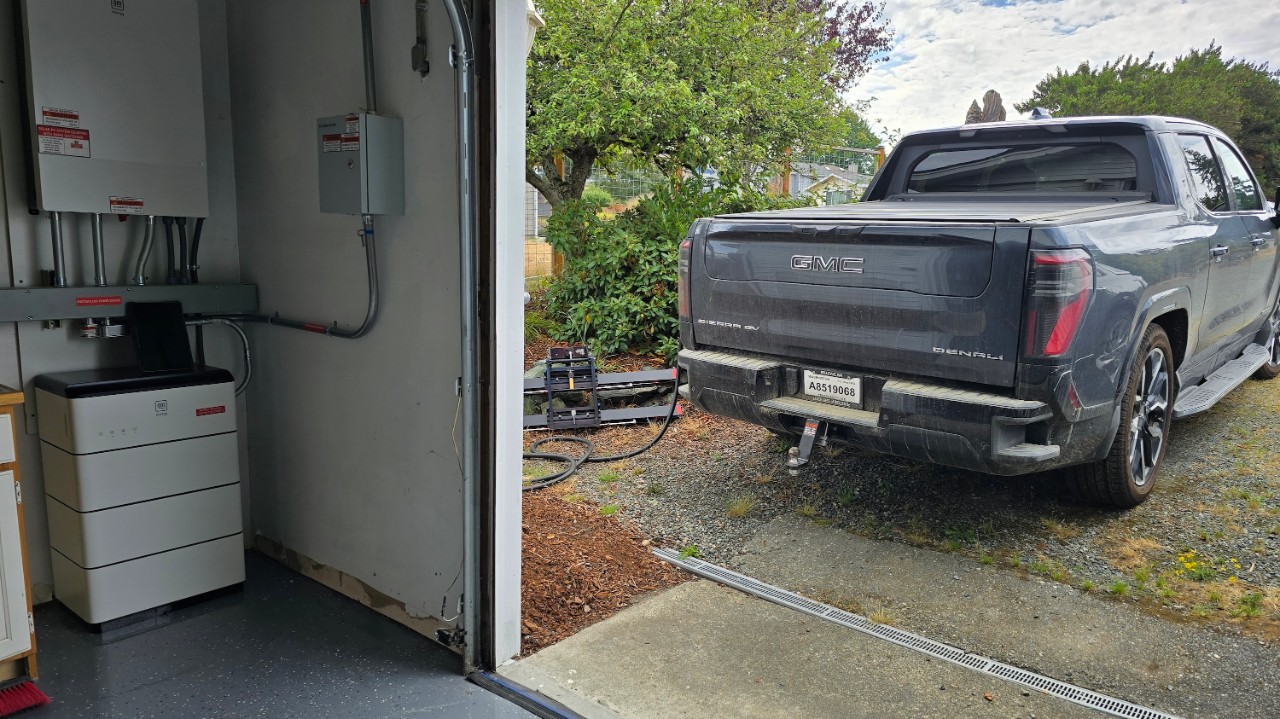
Vehicle-to-Home (V2H) + Solar refers to integrating a V2H-capable GM EV, compatible solar panels, and GM Energy V2H equipment to manage energy flow between the vehicle, the home, and onsite solar generation — enabling home backup power, increased solar consumption, and household energy management.
Jim Reilly, Group Manager of Portfolio Planning at GM Energy has solar on the roof of his Seattle home, a GM Energy PowerShift charger for his and his wife’s GM EVs, a 10.6-kWh GM Energy PowerBank, and a Home Hub and Inverter.
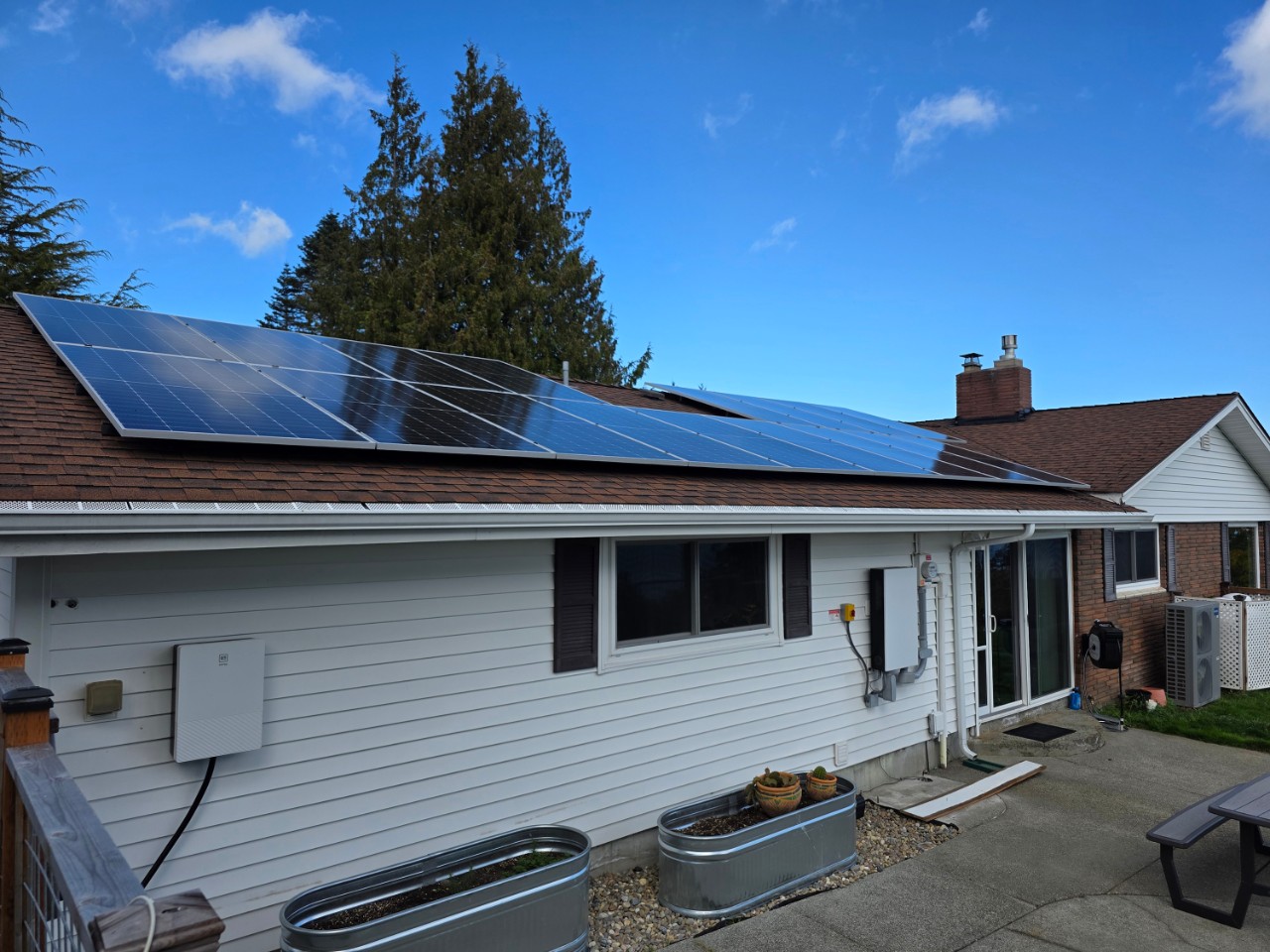
Seattle skies are frequently gray, so Reilly uses his GM Energy PowerBank to store solar energy whenever his panels can capture it for later use. He was able to use the system during a neighborhood-wide power outage over the holidays.
“People were coming to visit and every electrical appliance in our house was running,” Reilly says. “I asked my wife if we could slow down using our appliances to preserve energy. She totally forgot the power was out.”
Later, Reilly and his wife walked through their neighborhood, listening to the hum of gas-powered generators. Their driveway was notable for its silence.
Vehicle-to-Grid (V2G) technology will allow GM EVs to supply power back to the grid. In the future, select GM EVs may offer utilities an opportunity to enhance grid resilience and help to manage growing energy demand.
A Chevrolet, GMC, or Cadillac EV is, of course, a wonderful means of transportation. The very same battery that gets owners from point A to point B, has the potential to save day. GM Energy exists to tap into that potential, and employees are already reaping the benefits.