
By: Kyle Kinard, Managing Editor, GM News
By: Kyle Kinard, Managing Editor, GM News
The Formula 1® World Championship is effectively a two-hander, crowning the best driver on the grid and separately awarding the constructor that scores the most points. This split emphasizes Formula 1®’s duality as both the ultimate test of driver skill AND a proving ground for the best engineers on earth.
Ask anyone on the grid and they’ll tell you: one simply couldn’t happen without the other. To win a Formula 1® title, a driver needs the best car. To win a constructors’ championship, it takes a phenomenal talent behind the wheel.
And in the simulator.
In Episode Nine of What Makes Fast, the team dives deep into simulator calibration. The concept sounds alien at first but turns out to be a surprisingly human process. Off the back of a successful official F1® shakedown at Circuit de Barcelona-Catalunya, Cadillac Formula 1® Team drivers Valtteri Bottas and Checo Perez head straight back to the simulator in Charlotte.
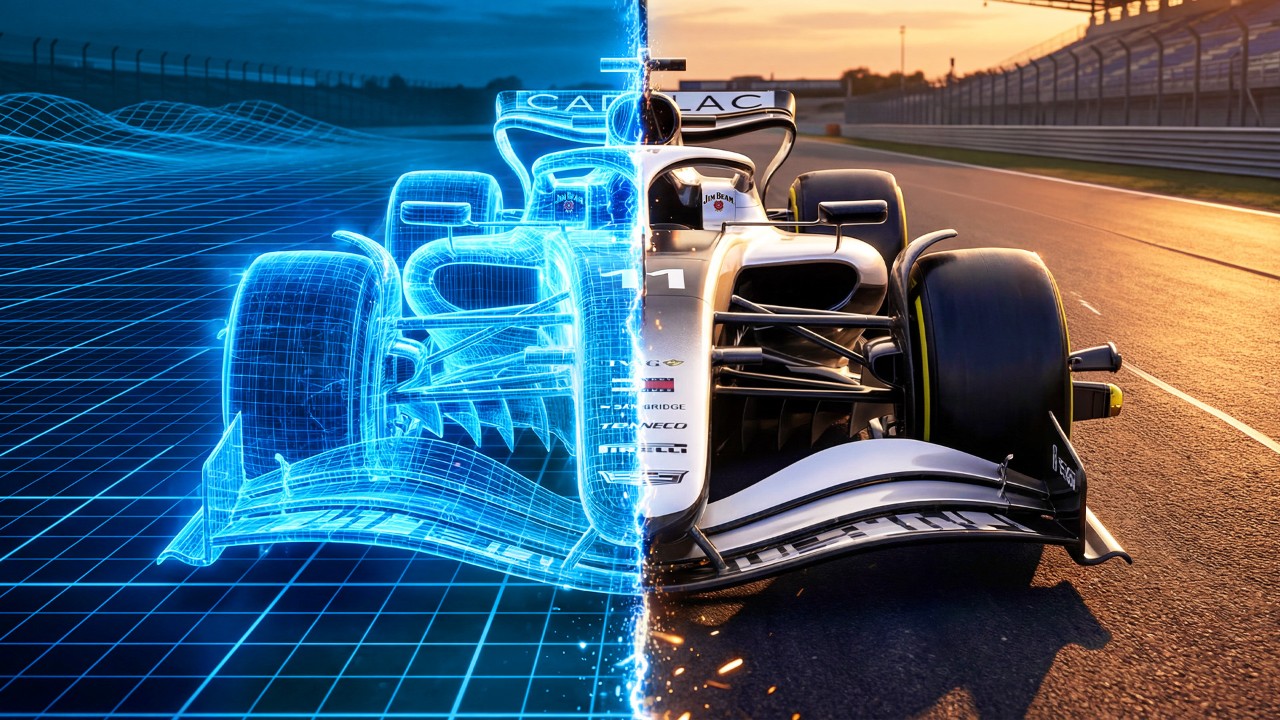
There, the drivers can compare their real-world impressions of the physical race car to the current state of the simulator. By calibrating the simulator to mirror the car’s real on-track behavior, the team can generate meaningful sim data and more accurately inform the race car.
It’s a circular feedback loop: If the simulator gets better, so does the car; data gathered from the car can then be more accurately incorporated in the simulator. And on.
So, the team meets in Charlotte to hash out that feedback loop as the first race weekend approaches in Australia. As ever, the first race offers both a fresh challenge on the track, and an opportunity to collect far more real-world data than has been available to the Cadillac Formula 1® Team before.
The video reminds us that every Formula 1® car is truly a prototype, and that constant improvement is the only way to the top of the pyramid, for both the drivers and engineers.
Watch episode nine below.
The Formula 1® World Championship is effectively a two-hander, crowning the best driver on the grid and separately awarding the constructor that scores the most points. This split emphasizes Formula 1®’s duality as both the ultimate test of driver skill AND a proving ground for the best engineers on earth.
Ask anyone on the grid and they’ll tell you: one simply couldn’t happen without the other. To win a Formula 1® title, a driver needs the best car. To win a constructors’ championship, it takes a phenomenal talent behind the wheel.
And in the simulator.
In Episode Nine of What Makes Fast, the team dives deep into simulator calibration. The concept sounds alien at first but turns out to be a surprisingly human process. Off the back of a successful official F1® shakedown at Circuit de Barcelona-Catalunya, Cadillac Formula 1® Team drivers Valtteri Bottas and Checo Perez head straight back to the simulator in Charlotte.
There, the drivers can compare their real-world impressions of the physical race car to the current state of the simulator. By calibrating the simulator to mirror the car’s real on-track behavior, the team can generate meaningful sim data and more accurately inform the race car.
It’s a circular feedback loop: If the simulator gets better, so does the car; data gathered from the car can then be more accurately incorporated in the simulator. And on.
So, the team meets in Charlotte to hash out that feedback loop as the first race weekend approaches in Australia. As ever, the first race offers both a fresh challenge on the track, and an opportunity to collect far more real-world data than has been available to the Cadillac Formula 1® Team before.
The video reminds us that every Formula 1® car is truly a prototype, and that constant improvement is the only way to the top of the pyramid, for both the drivers and engineers.
Watch episode nine below.