
By Stephen Harber, content strategist, GM Talent Marketing
By Stephen Harber, content strategist, GM Talent Marketing
COPY:
For John Kaychi, Senior Group Product Manager for Automated Driving at GM, the future of driving will be defined not only by technical progress, but by whether customers are ready to trust it.
At GM, he leads the product team working on eyes-off driving and how customers experience it. GM’s next major step in automated driving is planned to launch in 2028 beginning with the Cadillac ESCALADE IQ. “You can have the best technology in the world,” John says. “But if customers don’t trust it, it won’t stick.”
That perspective has shaped John’s career across startups, robotaxi development and now GM, where the focus is on turning advances in automated driving into safe, scalable customer experiences. He sees the AV industry evolving in three waves: Ridesharing changed behaviors. Robotaxis paved the way for autonomy. Retail, he believes, is where the industry will be tested at scale and has the ability to deliver the biggest customer benefit.
“That’s the edge we’re standing at today,” John says. “The technology is better understood. Hardware is approaching commoditization. The retail market is ready. True autonomy isn’t here yet, but GM is uniquely positioned to lead this next chapter, bringing automated driving to customers at scale.”
Transitioning from driverless demos to a mass-production retail product raises the bar: a controlled demonstration can show technical capability, while a customer product is designed to build confidence through consistent, validated performance over time.
Caption: John Kaychi helps put the pieces together for GM’s next step in automated driving, with a focus on safety, scale, and customer trust.
For John, two defining pillars anchor the work ahead: data and trust.
To prepare for real-world driving across the unforgiving "long tail"—inclement weather shifts, sudden road changes, and complex human traffic behavior—GM’s product and engineering teams validate against three rich data streams:
1) Production retail vehicles sold today, which can provide massive real-world fleet telemetry.
2) Next-generation development fleet data engineered for high-precision sensor capture.
3) And high-fidelity synthetic environments designed specifically to fill the gap on rare edge cases.
Together, these inputs feed a continuous validation loop that refines how the system performs while elevating how the experience feels to the customer. Retail vehicle data is collected with safeguards designed to protect customer privacy. Across each source, data is collected in a disciplined, prioritized manner—focusing systematically on the operational domains that aim to deliver the highest customer value at every step of deployment.
“It’s not just about how the system drives,” John emphasizes. “It’s about how it makes the driver feel. And we’re building for both.”
John’s perspective was forged in real-world experience. During his tenure at Zoox, he helped launch the company's first employee ridesharing service, deploying autonomous vehicles onto San Francisco's most demanding terrains—steep city hills, blind crests, and dense urban corridors around Coit Tower and Lombard Street.
“Getting to see the technology through the eyes of so many people who hadn’t experienced it before reminded me how groundbreaking this technology is and how close we were to making it a reality—especially when operating in a real-world setting with real-world complexity,” John reflects. “That moment showed me what was possible, and it continues to shape how I approach scaling autonomy at GM.”
At GM, that startup momentum transforms into production-grade product discipline: moving with speed and urgency while prioritizing standards for safety, build quality, and daily consumer utility.
“There’s a different kind of wisdom required when deploying at automotive scale,” John notes. “Every decision has to reinforce trust and quality. You don’t just chase speed—you protect the brand.”
Before eyes-off driving reaches retail customers, GM is bringing together two proven foundations: the production scale of Super Cruise and the autonomous expertise of Cruise. Super Cruise demonstrates GM’s experience scaling complex driver-assistance technology across millions of customer miles.. GM is now combining that real-world experience with Cruise’s expertise in AI development and complex testing. Together, those strengths help validate and refine next-generation driving capabilities.
That is why GM’s strategy relies on a deliberate, domain-by-domain rollout, validating each capability against real-world conditions before expanding into the next. For John, that disciplined approach is what unlocks the ultimate value of eyes-off autonomy: giving drivers their time back.
“Eyes-off driving fundamentally changes what routine travel feels like,” John explains. “It transforms time spent behind the wheel into personal bandwidth—giving people space to work, think, or simply relax. Automated driving has the power to reclaim that time, and that’s what makes this work so deeply motivating.”
GM NEWS CTA SECTION
Discover GM’s autonomous driving work
Read more about the people and technologies advancing AV at General Motors.
Interested in helping drive the future of AV? Explore Autonomy careers at GM
Forward-Looking Statements: This article includes forward-looking statements within the meaning of the U.S. federal securities laws. Actual results may differ due to risks and uncertainties as further described in GM’s Annual Report on Form 10-K and Quarterly Reports on Form 10-Q as publicly filed and available with the Securities and Exchange Commission.
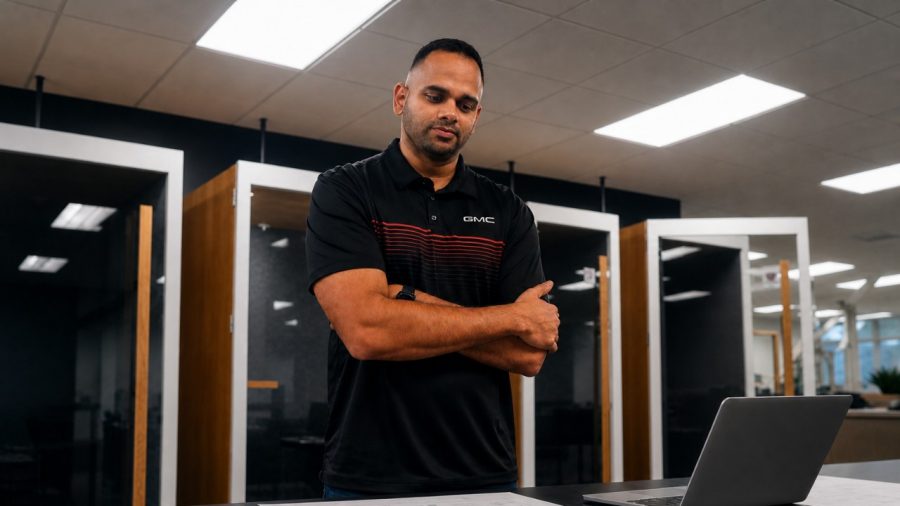
For John Kaychi, Senior Group Product Manager for Automated Driving at GM, the future of driving will be defined not only by technical progress, but by whether customers are ready to trust it.
At GM, he leads the product team working on eyes-off driving and how customers experience it. GM’s next major step in automated driving is planned to launch in 2028 beginning with the Cadillac ESCALADE IQ. “You can have the best technology in the world,” John says. “But if customers don’t trust it, it won’t stick.”
That perspective has shaped John’s career across startups, robotaxi development and now GM, where the focus is on turning advances in automated driving into safe, scalable customer experiences. He sees the AV industry evolving in three waves: Ridesharing changed behaviors. Robotaxis paved the way for autonomy. Retail, he believes, is where the industry will be tested at scale and has the ability to deliver the biggest customer benefit.
“That’s the edge we’re standing at today,” John says. “The technology is better understood. Hardware is approaching commoditization. The retail market is ready. True autonomy isn’t here yet, but GM is uniquely positioned to lead this next chapter, bringing automated driving to customers at scale.”
Transitioning from driverless demos to a mass-production retail product raises the bar: a controlled demonstration can show technical capability, while a customer product is designed to build confidence through consistent, validated performance over time.
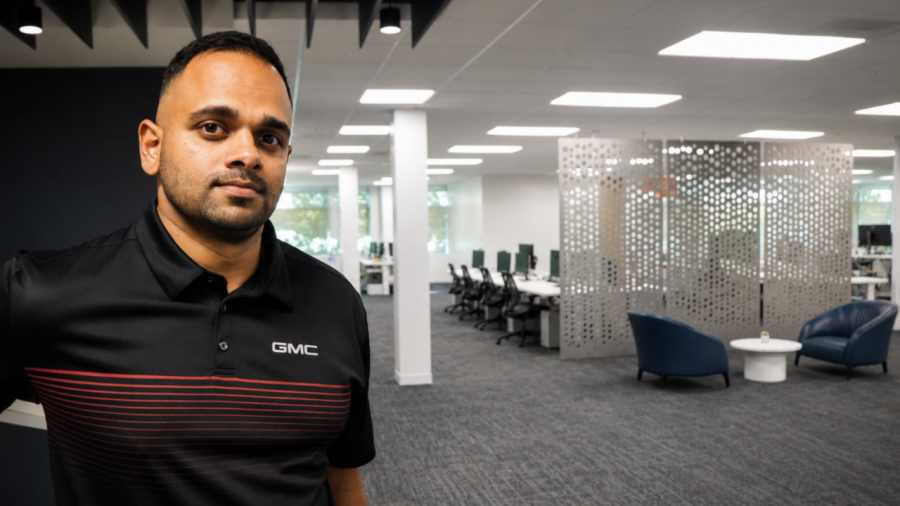
For John, two defining pillars anchor the work ahead: data and trust.
To prepare for real-world driving across the unforgiving "long tail"—inclement weather shifts, sudden road changes, and complex human traffic behavior—GM’s product and engineering teams validate against three rich data streams:
- Production retail vehicles sold today, which can provide massive real-world fleet telemetry.
- Next-generation development fleet data engineered for high-precision sensor capture.
- And high-fidelity synthetic environments designed specifically to fill the gap on rare edge cases.
Together, these inputs feed a continuous validation loop that refines how the system performs while elevating how the experience feels to the customer. Retail vehicle data is collected with safeguards designed to protect customer privacy. Across each source, data is collected in a disciplined, prioritized manner—focusing systematically on the operational domains that aim to deliver the highest customer value at every step of deployment.
“It’s not just about how the system drives,” John emphasizes. “It’s about how it makes the driver feel. And we’re building for both.”
John’s perspective was forged in real-world experience. During his tenure at Zoox, he helped launch the company's first employee ridesharing service, deploying autonomous vehicles onto San Francisco's most demanding terrains—steep city hills, blind crests, and dense urban corridors around Coit Tower and Lombard Street.
“Getting to see the technology through the eyes of so many people who hadn’t experienced it before reminded me how groundbreaking this technology is and how close we were to making it a reality—especially when operating in a real-world setting with real-world complexity,” John reflects. “That moment showed me what was possible, and it continues to shape how I approach scaling autonomy at GM.”
At GM, that startup momentum transforms into production-grade product discipline: moving with speed and urgency while prioritizing standards for safety, build quality, and daily consumer utility.
“There’s a different kind of wisdom required when deploying at automotive scale,” John notes. “Every decision has to reinforce trust and quality. You don’t just chase speed—you protect the brand.”
Before eyes-off driving reaches retail customers, GM is bringing together two proven foundations: the production scale of Super Cruise and the autonomous expertise of Cruise. Super Cruise demonstrates GM’s experience scaling complex driver-assistance technology across millions of customer miles. GM is now combining that real-world experience with Cruise’s expertise in AI development and complex testing. Together, those strengths help validate and refine next-generation driving capabilities.
That is why GM’s strategy relies on a deliberate, domain-by-domain rollout, validating each capability against real-world conditions before expanding into the next. For John, that disciplined approach is what unlocks the ultimate value of eyes-off autonomy: giving drivers their time back.
“Eyes-off driving fundamentally changes what routine travel feels like,” John explains. “It transforms time spent behind the wheel into personal bandwidth—giving people space to work, think, or simply relax. Automated driving has the power to reclaim that time, and that’s what makes this work so deeply motivating.”
Discover GM’s autonomous driving work
Read more about the people and technologies advancing AV at General Motors.
- Everything you need to know about Super Cruise today, and what’s next for the tech
- GM begins supervised public-road testing of next-generation automated technology
- Simulation at scale: Inside GM’s autonomous vehicle development
Interested in helping drive the future of AV? Explore Autonomy careers at GM
Forward-Looking Statements: This article includes forward-looking statements within the meaning of the U.S. federal securities laws. Actual results may differ due to risks and uncertainties as further described in GM’s Annual Report on Form 10-K and Quarterly Reports on Form 10-Q as publicly filed and available with the Securities and Exchange Commission.
Learn more about careers at GM by visiting Careers.GM.com.