
By: Chris Perkins, Senior Writer & Editor, GM News
By: Chris Perkins, Senior Writer & Editor, GM News
For its full century-plus history, General Motors has helped define the future, dreaming up what could come next and turning it into reality. Much of what GM is working on today – more capable autonomous systems, more affordable and efficient EVs, smarter connectivity features, a powerful central compute and electrical architecture – started decades ago. Here’s a look back at how GM’s past experiments helped inform today’s automobile and paved the way for tomorrow’s advances.
Driver Assistance and Autonomy
Caption: A scene from the 1939 Futurama exhibit, showing the highway of the future.
It was 1939 when GM first asked the American public to imagine a future with autonomous driving. At that year’s World’s Fair, GM presented Futurama, an exhibition that saw attendees ride on a conveyor belt of moving chairs above models depicting visions of the far-off world of 1960.
Created by industrial designer Norman Bel Geddes, Futurama imagined a level of automated driver assistance, with radio controls helping maintain safe distances between vehicles and assisted lane changes, all taking place on a futuristic superhighway.
In the 1950s, GM expanded on the idea of a self-driving car. At the 1956 Motorama exhibition, the company showed “Key to the Future,” a musical short film featuring a family riding in the Firebird II concept in an “Auto Pilot” mode, cruising hands-free from Phoenix to Chicago. The family communicates with a control tower, where an operator provides them a choice of routes and instructs the driver when it’s safe to go hands-free. Later in that same decade, the 1959 Cadillac Cyclone concept featured radars in the nose of the vehicle that could measure the cruising distance to vehicles ahead.
Caption: The 1956 GM Firebird II concept and 1959 Cadillac Cyclone concept.
These ideas were radical for their time, and while they remained science-fiction for decades, they’re no longer fantasy. The 2004 Cadillac XLR introduced GM’s first iteration of radar-based adaptive cruise control, which could automatically maintain a driver-set following distance to the car ahead. It’s a feature that’s now available in many GM vehicles.
In 2017, GM unveiled Super Cruise1, the world’s first automotive hands-free driver assistance system. Unlike what the company imagined with Firebird II, Super Cruise doesn’t require contacting a control tower – just press the button on a Super Cruise-enabled road and enjoy hands-free driving. Connectivity works in the background to bring to life a simple customer experience. GM will launch personal autonomy in 2028 with the Cadillac ESCALADE IQ, bringing us closer to the world we’ve imagined for decades.
EVs
In the 1960s, GM engineers started charting the path for modern electric vehicles. The Electrovair II of 1966 was based on a Chevrolet Corvair sedan, but instead of internal-combustion power, it used silver-zinc batteries to drive an electric motor.
Electrovair II placeholder image.
This experimental vehicle was really an attempt at studying the feasibility of EVs in the face of impending emissions regulations. The Electrovair II’s silver-zinc battery pack cost over $150,000 in 2026 dollars, and by modern standards it was severely limited in range and charging capability -- figure a maximum of 80 miles of range, 6-8 hours of charge time, and only 100 discharge cycles before the battery needed to be replaced.
Despite that, the Electrovair II achieved its goal, showing that a practical EV could one day become a reality. In 1969, GM engineers created the tiny XP 512E, a city car powered by lead-acid batteries. At just 1,250 pounds, the XP 512E was far lighter than the Electovair II, but it was only capable of a top speed of 30 MPH. Later in the 1970s, the Electrovette, based on the contemporary Chevette, used conventional lead-acid batteries to preview a future city car.
A couple decades would pass before EVs became truly feasible. First previewed by the 1990 IMPACT concept, the 1997 GM EV1 was the first modern, mass-produced electric car, filled with pioneering technology. Much of the thinking behind the EV1 lives on in today’s GM EVs.
Connectivity
Around the time the Electrovair II was in development, General Motors Research was working on an early version of the connected car. The Driver Aid, Information, and Routing (DAIR) system provided motorists with information on road and traffic conditions, navigation, and radio communication using 1966 technology.
The DAIR unit in the car could receive automated messages and signals on potential road hazards by communicating with low-powered transmitters embedded in roadway infrastructure. CB radio also enabled real-time communications with live operators at a control center, while passengers could insert coded punch cards into the dashboard to receive turn-by-turn directions to a specific destination.
After demonstrating DAIR at its Global Technical Center in Warren, Michigan, GM received a contract with the federal government to develop the Experimental Route Guidance System (ERGS), an expansion on DAIR’s navigation system. Instead of using a punch card, EGRS relied on a five-letter code that drivers would input. The ERGS unit would then receive signals from magnets and transmitters embedded at road intersections.
One imagines the amount of infrastructure required to make DAIR and ERGS a reality in the late 1960s was prohibitive, but by the 1990s, the idea was revived and modernized with OnStar2. The rise of mobile telecommunications and the Global Positioning System (GPS) allowed GM to connect its cars to live OnStar Advisors in case of an emergency. Soon, OnStar came to encompass a number of convenience features, evolved with mobile apps and Wi-Fi capability, and today, enables hands-free – and soon, autonomous highway – driver assistance with Super Cruise.
Microprocessors
Image placeholder
In the early 1970s, the first microprocessors hit the market and kicked off a computing revolution. Later in that same decade, GM helped pioneer their automotive use. The 1977 Oldsmobile Toronado debuted an industry-first microprocessor-powered digital computer to control engine ignition – essentially, a computer telling each spark plug when to fire for maximum performance and efficiency. Not long after, the 1978 Cadillac Seville used a microprocessor to power the world’s first automotive trip computer, which allowed drivers to compute average fuel economy, speed, range, and time to destination.
As the 1980s dawned, GM vehicles started using microprocessors in a big way. By 1981, GM vehicles featured Computer Command Control (CCC), a revolutionary system that used data inputs from a suite of sensors to control the engine and transmission.
CCC brought benefits in both fuel economy and emissions, and introduced electronic vehicle diagnostics to the automotive world. In the years after, GM vehicles grew to incorporate a number of computer modules to control many more vehicle functions.
Microprocessors also led to GM introducing the industry’s first touchscreen with the 1986 Buick Riviera’s Graphic Control Center, a cathode-ray tube (CRT) display with resistive touch technology.
These days, GM is rethinking the way it uses microprocessors in cars. Rather than using several computer modules to control discrete vehicle systems, GM’s new software-defined vehicle (SDV) architecture will use a central compute and a handful of “aggregators” to create a unified computing platform. This will unlock huge processing power, which in turn will allow for more advanced AI, autonomy, and infotainment functionality across the GM lineup.
What’s Next
This history of innovation inspires and informs GM’s engineering today. Next week, at GM Forward 2026, the company will present an in-depth look at its vision of the future. Stay tuned.
1. Always pay attention while driving and when using Super Cruise. Always use Super Cruise in accordance with local laws. Do not use a hand-held device. Requires active Super Cruise plan or trial. Terms apply. Visit OnStar.com/feature/super-cruise for compatible roads and full details.
2. See onstar.com for details and limitations. Services vary by model. Service plan required.
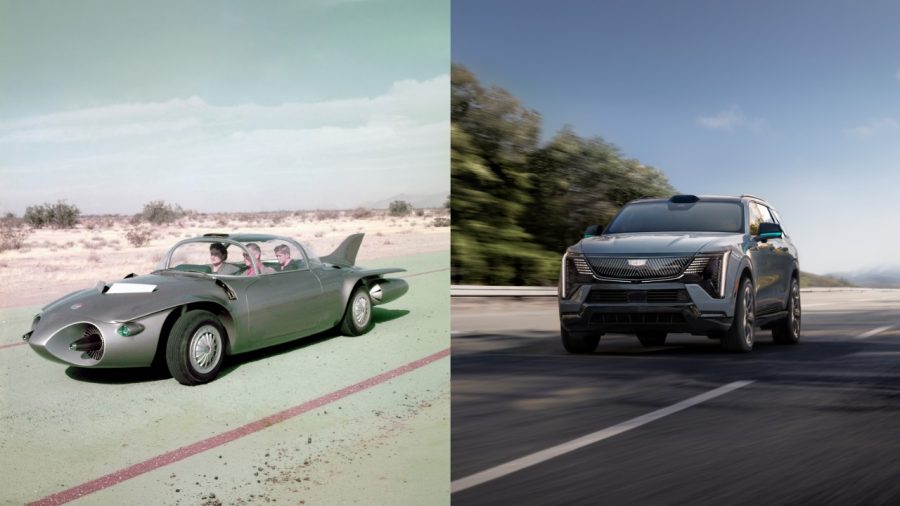
For its full century-plus history, General Motors has helped define the future, dreaming up what could come next and turning it into reality. Much of what GM is working on today – more capable autonomous systems, more affordable and efficient EVs, smarter connectivity features, a powerful central compute and electrical architecture – started decades ago. Here’s a look back at how GM’s past experiments helped inform today’s automobile and paved the way for tomorrow’s advances.
Driver Assistance and Autonomy
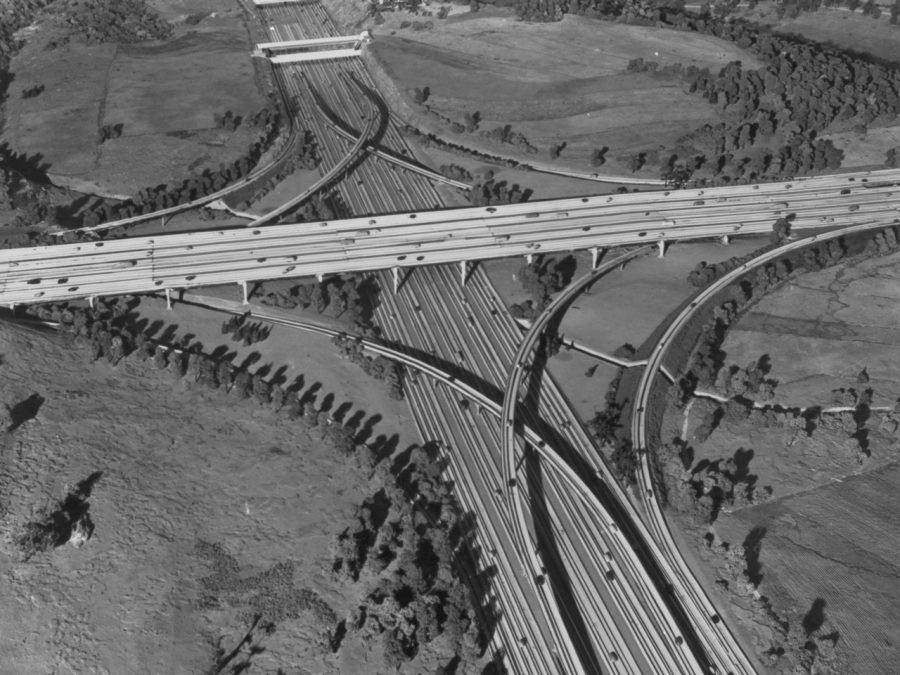
It was 1939 when GM first asked the American public to imagine a future with autonomous driving. At that year’s World’s Fair, GM presented Futurama, an exhibition that saw attendees ride on a conveyor belt of moving chairs above models depicting visions of the far-off world of 1960.
Created by industrial designer Norman Bel Geddes, Futurama imagined a level of automated driver assistance, with radio controls helping maintain safe distances between vehicles and assisted lane changes, all taking place on a futuristic superhighway.
In the 1950s, GM expanded on the idea of a self-driving car. At the 1956 Motorama exhibition, the company showed “Key to the Future,” a musical short film featuring a family riding in the Firebird II concept in an “Auto Pilot” mode, cruising hands-free from Phoenix to Chicago. The family communicates with a control tower, where an operator provides them a choice of routes and instructs the driver when it’s safe to go hands-free. Later in that same decade, the 1959 Cadillac Cyclone concept featured radars in the nose of the vehicle that could measure the cruising distance to vehicles ahead.

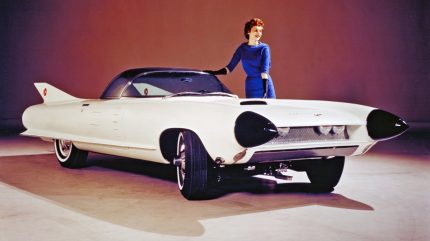
The 1956 GM Firebird II concept (left) and 1959 Cadillac Cyclone concept (right).
These ideas were radical for their time, and while they remained science-fiction for decades, they’re no longer fantasy. The 2004 Cadillac XLR introduced GM’s first iteration of radar-based adaptive cruise control, which could automatically maintain a driver-set following distance to the car ahead. It’s a feature that’s now available in many GM vehicles.

In 2017, GM unveiled Super Cruise1, the world’s first automotive hands-free driver assistance system. Unlike what the company imagined with Firebird II, Super Cruise doesn’t require contacting a control tower – just press the button on a Super Cruise-enabled road and enjoy hands-free driving. Connectivity works in the background to bring to life a simple customer experience. GM will launch personal autonomy in 2028 with the Cadillac ESCALADE IQ, bringing us closer to the world we’ve imagined for decades.
Electric Vehicles
In the 1960s, GM engineers started charting the path for modern electric vehicles. The Electrovair II of 1966 was based on a Chevrolet Corvair sedan, but instead of internal-combustion power, it used silver-zinc batteries to drive an electric motor.


The 1966 Electrovair II.
This experimental vehicle was really an attempt at studying the feasibility of EVs in the face of impending emissions regulations. The Electrovair II’s silver-zinc battery pack cost over $150,000 in 2026 dollars, and by modern standards it was severely limited in range and charging capability – figure a maximum of 80 miles of range, 6-8 hours of charge time, and only 100 discharge cycles before the battery needed to be replaced.
Despite that, the Electrovair II achieved its goal, showing that a practical EV could one day become a reality. In 1969, GM engineers created the tiny XP 512E, a city car powered by lead-acid batteries. At just 1,250 pounds, the XP 512E was far lighter than the Electovair II, but it was only capable of a top speed of 30 MPH. Later in the 1970s, the Electrovette, based on the contemporary Chevette, used conventional lead-acid batteries to preview a future city car.
A couple decades would pass before EVs became truly feasible. First previewed by the 1990 IMPACT concept, the 1997 GM EV1 was the first modern, mass-produced electric car, filled with pioneering technology. Much of the thinking behind the EV1 lives on in today’s GM EVs.
Connectivity

Around the time the Electrovair II was in development, General Motors Research was working on an early version of the connected car. The Driver Aid, Information, and Routing (DAIR) system provided motorists with information on road and traffic conditions, navigation, and radio communication using 1966 technology.
The DAIR unit in the car could receive automated messages and signals on potential road hazards by communicating with low-powered transmitters embedded in roadway infrastructure. CB radio also enabled real-time communications with live operators at a control center, while passengers could insert coded punch cards into the dashboard to receive turn-by-turn directions to a specific destination.
After demonstrating DAIR at its Global Technical Center in Warren, Michigan, GM received a contract with the federal government to develop the Experimental Route Guidance System (ERGS), an expansion on DAIR’s navigation system. Instead of using a punch card, EGRS relied on a five-letter code that drivers would input. The ERGS unit would then receive signals from magnets and transmitters embedded at road intersections.
One imagines the amount of infrastructure required to make DAIR and ERGS a reality in the late 1960s was prohibitive, but by the 1990s, the idea was revived and modernized with OnStar2. The rise of mobile telecommunications and the Global Positioning System (GPS) allowed GM to connect its cars to live OnStar Advisors in case of an emergency. Soon, OnStar came to encompass a number of convenience features, evolved with mobile apps and Wi-Fi capability, and today, enables hands-free – and soon, autonomous highway – driver assistance with Super Cruise.
Microprocessors

In the early 1970s, the first microprocessors hit the market and kicked off a computing revolution. Later in that same decade, GM helped pioneer their automotive use. The 1977 Oldsmobile Toronado debuted an industry-first microprocessor-powered digital computer to control engine ignition – essentially, a computer telling each spark plug when to fire for maximum performance and efficiency. Not long after, the 1978 Cadillac Seville used a microprocessor to power the world’s first automotive trip computer, which allowed drivers to compute average fuel economy, speed, range, and time to destination.
As the 1980s dawned, GM vehicles started using microprocessors in a big way. By 1981, GM vehicles featured Computer Command Control (CCC), a revolutionary system that used data inputs from a suite of sensors to control the engine and transmission.
CCC brought benefits in both fuel economy and emissions, and introduced electronic vehicle diagnostics to the automotive world. In the years after, GM vehicles grew to incorporate a number of computer modules to control many more vehicle functions.
Microprocessors also led to GM introducing the industry’s first touchscreen with the 1986 Buick Riviera’s Graphic Control Center, a cathode-ray tube (CRT) display with resistive touch technology.
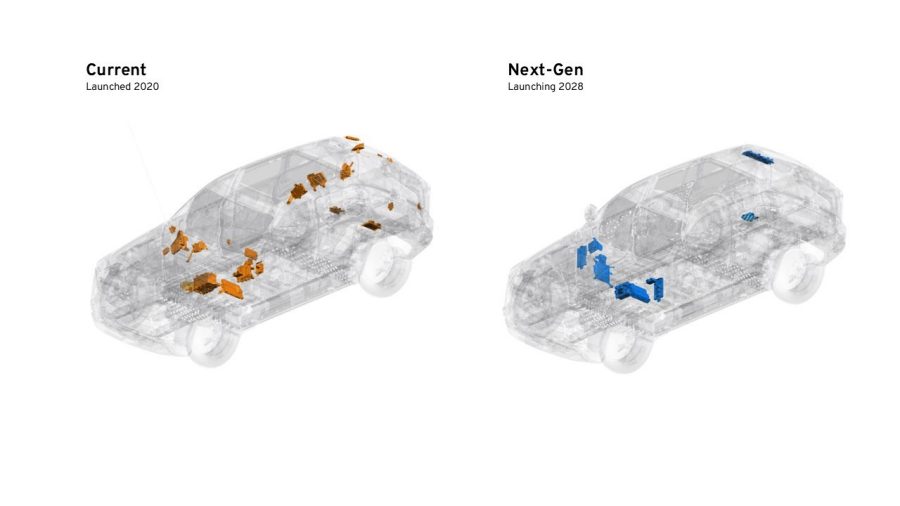
These days, GM is rethinking the way it uses microprocessors in cars. Rather than using several computer modules to control discrete vehicle systems, GM’s new software-defined vehicle (SDV) architecture will use a central compute and a handful of “aggregators” to create a unified computing platform. This will unlock huge processing power, which in turn will allow for more advanced AI, autonomy, and infotainment functionality across the GM lineup.
What’s Next
This history of innovation inspires and informs GM’s engineering today. Next week, at GM Forward 2026, the company will present an in-depth look at its vision of the future. Stay tuned.
1Always pay attention while driving and when using Super Cruise. Always use Super Cruise in accordance with local laws. Do not use a hand-held device. Requires active Super Cruise plan or trial. Terms apply. Visit OnStar.com/feature/super-cruise for compatible roads and full details.
2See onstar.com for details and limitations. Services vary by model. Service plan required.